Each June, Pride Month brings people together to celebrate the LGBTQ+ community through parades, parties, marches, and other events. But behind today’s colorful celebrations is a deeper history that began decades ago, rooted in activism, resistance, and the fight for equality.
Pride is a time to honor queer joy, but it’s also a chance to better understand the meaning behind the month—from its origins in the 1960s to the symbolism of the rainbow flag. Whether you’re attending a local event or simply want to learn more, these Pride Month facts offer helpful context on why the celebration matters.
1. The Stonewall Riots inspired Pride Month
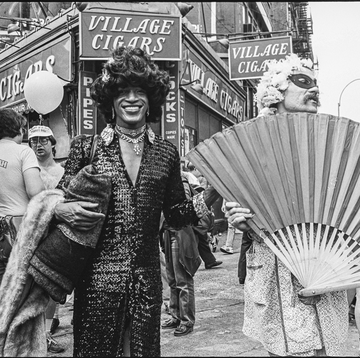
Some of you may know this one, but June was designated Pride Month because the uprising at the Stonewall Inn began on June 28, 1969. The Stonewall Inn is a gay bar in New York City that was raided by the police on that night. Police raids of gay bars were fairly common, but this event shifted the course of history. LGBTQ+ people and allies fought back against the police, which led to an uprising that lasted for six days. Thanks to the heroes of the riots at the Stonewall Inn, like Marsha P. Johnson, a Black transgender woman, this event is an iconic marker in the fight for LGBTQ+ rights that helped lead the way to Pride Month as we celebrate it today.

2. The first Pride flag was Harvey Milk's idea
Harvey Milk was an activist and the first openly gay man elected to office in California (and one of the first openly gay elected officials in America). Milk was adamant on publicly advocating for LGBTQ+ rights, and he was able to help pass a gay rights ordinance that banned anti-LGBTQ+ discrimination in housing and employment in San Francisco.

While Milk significantly contributed to the LGBTQ+ rights movement in various ways, a lesser-known fact is that he sparked the idea of creating a symbol for gay pride. Milk asked artist Gilbert Baker to create a symbol, who then designed the first rainbow Pride flag in 1978, which has remained an iconic symbol representing the LGBTQ+ community for decades. To learn more about Milk, you can watch the movie Milk, which is based on his life and activism in San Francisco.
3. The original Pride flag had nine colors
Sad news for fans of pink and turquoise: these colors were originally part of the first Pride flag Baker designed in 1978. Turquoise was removed as a design choice by Baker, but the pink stripe was removed due to a lack of pink fabric, which became an issue as demand forPride flags increased after the assassination of Harvey Milk. This led to the creation of the most widely known Pride flag with only red, orange, yellow, green, indigo and violet.
While the six-color Pride flag is still the most commonly used, its most recent design update was in 2021, when the Intersex-Inclusive Progress Pride Flag was created. This flag includes a triangle on the left-hand portion of the flag to represent the communities of color, those lost during the HIV/AIDS crisis and non-binary, intersex and transgender people in the LGBTQ+ community.
You can check out all the variations of the Pride Flag over the years and learn more about each flag's history on the Human Rights Campaign's (HRC) website
4. Each color in the Pride flag has a special meaning

Speaking of the colors of the Pride flag, each color has its own meaning. While this is technically a fun fact about the flag, Pride flags are most often waved and displayed during Pride Month, and it's an interesting tidbit of queer history. The meanings of each color on the six-color flag are as follows:
- Red: Life
- Orange: Healing
- Yellow: Sunlight
- Green: Nature
- Indigo: Serenity
- Violet: The spirit of LGBTQ+ people
In the original flag, pink represented sex and turquoise symbolized magic and art. The newest rendition of the flag (the Intersex-Inclusive Progress Pride Flag) includes black and brown stripes to represent communities of color within the LGBTQ+ community, and the black stripe also serves as a nod to those lost during the HIV/AIDS crisis. The light pink and blue represent the transgender community, and the yellow triangle with a purple circle symbolizes intersex people.
5. Before Pride Month existed, there was Christopher Street Liberation Day
To commemorate the one-year anniversary of the Stonewall Uprising, the first Pride March in NYC, called "Christopher Street Liberation Day," was held on June 28, 1970. Los Angeles also held a Pride celebration on the same day, but New York City's was much larger, with reports that a crowd of thousands stretched for15 blocks. It was then celebrated annually on the last Sunday of June, and people called this by a variety of names over the years, including "Gay Pride Day."
6. President Bill Clinton declared June as "Gay and Lesbian Pride Month" in 1999

NYC has held a Pride March every year since 1970 (excluding 2020 and 2021 due to the COVID-19 pandemic), ultimately helping to establish June as Pride Month. In a search through an online archive done by NBCU Academy, it was found that the first mention of "Pride Month" in a newspaper was in June 1972. "We call it Gay Pride week and Gay Pride Month, the whole month of June," gay activist Byrna Aronson was quoted. Over the years, more and more events took place throughout June in cities across the country.
Pride Month was officially recognized by the U.S. Government in 1999, when former President Bill Clinton declared June as “Gay and Lesbian Pride Month." President Barack Obama proclaimed it "LGBT Pride Month" in 2009 to be more inclusive. President Joe Biden further expanded the observance to “Lesbian, Gay, Bisexual, Transgender, and Queer (LGBTQ+) Pride Month.”
So, while the weather in June is pleasant, there's more to the decision than just great weather for parades!
7. More than 30 different flags represent the LGBTQ+ community
One last fact about the Pride flag: the iconic rainbow flags are umbrella flags, meaning they represent the entire LGBTQ+ community as one unit. However, there are more than 30 flags to represent the variety of sexualities, gender identities and more within the LGBTQ+ community.
The lesbian flag features hues of pink and orange, while bisexuals are represented by a dark blue, pink and purple flag. The transgender flag has blue, pink and white stripes, but it can be even more specific if you want a non-binary flag (yellow, white, purple and black) or a gender queer flag (purple, white and green). There are tons more Pride flags representing various identities that help others feel seen.

Why so many flags? Pride flags help raise awareness and show support of the community, so specific flags for each identity in the LGBTQ+ community is a way to support individual labels. Plus, for some people, it is a way to silently signal to others that they identify with a specific label in the LGBTQ+ community. Whether it's a pin on a shirt, a flag on a front door or a sticker on a water bottle, others can see that they identify as gay, a lesbian, non-binary, pansexual, bisexual, asexual, transgender or one of the many other identities.
8. The biggest Pride parade is in Brazil

The Stonewall Inn is located in New York City's West Village, but the riots sparked the LGBTQ+ rights movement in the U.S. and had major impacts worldwide. For years, the NYC Pride March was the largest Pride parade in the world, but a different city has claimed that title in recent years.
The largest Pride parade in the world is now considered to be Parada do Orgulho LGBTQ de São Paulo, also known as São Paulo Gay Pride. In 2024, more than 4 million people attended São Paulo Gay Pride (around 2.5 million attended the NYC Pride March), earning it the Guinness World Record title for the biggest Pride parade in the world. The turnout is even more impressive considering the event had only 2,000 participants at the first parade in 1997, 27 years after NYC's first Pride March in 1970.