Expert consulted:

If your go-to bras have straps that slip, gaping cups, or stretched-out elastic bands, it’s definitely time for a new one. We asked experts how to measure your bra size correctly so that you can find one that fits perfectly.
Pros say that many people mistakenly end up wearing bras that don’t quite fit. Even if you think you’re wearing the right size, it’s worth taking your measurements again before ordering a new bra. After all, bodies change, which means your bra size can change. You’ll also want to pay attention to the shape of your breasts and read up on your “sister size” in case you find a bra where the cups fit perfectly, but the band is a little off. According to pros, this is a relatively common fitting issue when it comes to bras.
Whether you’re looking for a comfortable daily bra or a supportive strapless bra to wear to an upcoming event, lingerie designers and Good Housekeeping editors have tips to help you find the perfect fit. Below, experts explain the signs that your bra doesn’t fit, how to properly measure yourself for a new bra, and tips to help your bra stay supportive for longer.
Jump to:
First, here's how to tell if your bra doesn't fit
- Your band is riding up your back. A band that's sitting high, even on the tightest hook, means it's stretched out or too loose. One of the most common mistakes is having the band be too large, and the cups too small.
- Your cups are digging into your breasts. If your breast tissue is spilling out of the cups and you can see a "double boob" in tight-fitting shirts, your cups are too small.
- Your cups gape, or you shift out of your cups as you move. This means your cups are too large (or the wrong shape) for your breasts.
- Your straps keep slipping. If, no matter how many times you tighten them, your straps keep falling off your shoulders, they've lost their elasticity.
- Your bra is showing visible signs of wear. If the underwire has poked through the fabric or if the edges straps are frayed and worn, it's time for a new bra.
How to find your bra size with a measuring tape

You should be measuring your bra size yearly to ensure full comfort in your underpinnings. Here's how:
Step 1: Find your bra band size
Wearing an unlined, non-padded bra (not over your clothes!) or a fitted T-shirt, run the measuring tape all the way around your back where your band sits, being careful to keep the tape level. "Take a couple deep breaths and make sure the band isn't too snug — you should be able to comfortably fit two fingers beneath the tape measure," says Emma Seymour, associate director of the Good Housekeeping Institute Textiles Lab. That number is your band size.
If you don't get a whole number (e.g. 33 and 1/2 inches), or you get an odd number that's between traditional band sizes (e.g. 33 inches), round up to the nearest whole, even number (34 inches).
Step 2: Measure your bust
Run the measuring tape around your back, just under your shoulder blades, and up around the fullest part of your bust. The tape should just skim the bra in front.
Step 3: Calculate to find your cup and bra size
Subtract your band size from your bust measurement to find your cup size. The difference in inches corresponds to your cup size; 1 inch is an A cup, 2 inches is a B, etc. For example, if your bust measures 37 inches and your band size is 34, the difference will be 3, which is equal to a C cup, meaning your bra size is 34C.
How to find your bra size without a measuring tape
No measuring tape? No problem! You can easily measure yourself with a household item like "a piece of string or ribbon — just make sure it’s not stretchy," says Seymour. "Then, measure your bust and band sizes with the string, and then you can measure the length of the ribbon with a ruler." As with the measuring tape, you'll want to be sure that your string is level and isn't too snug around your back and bust.
Bra size chart
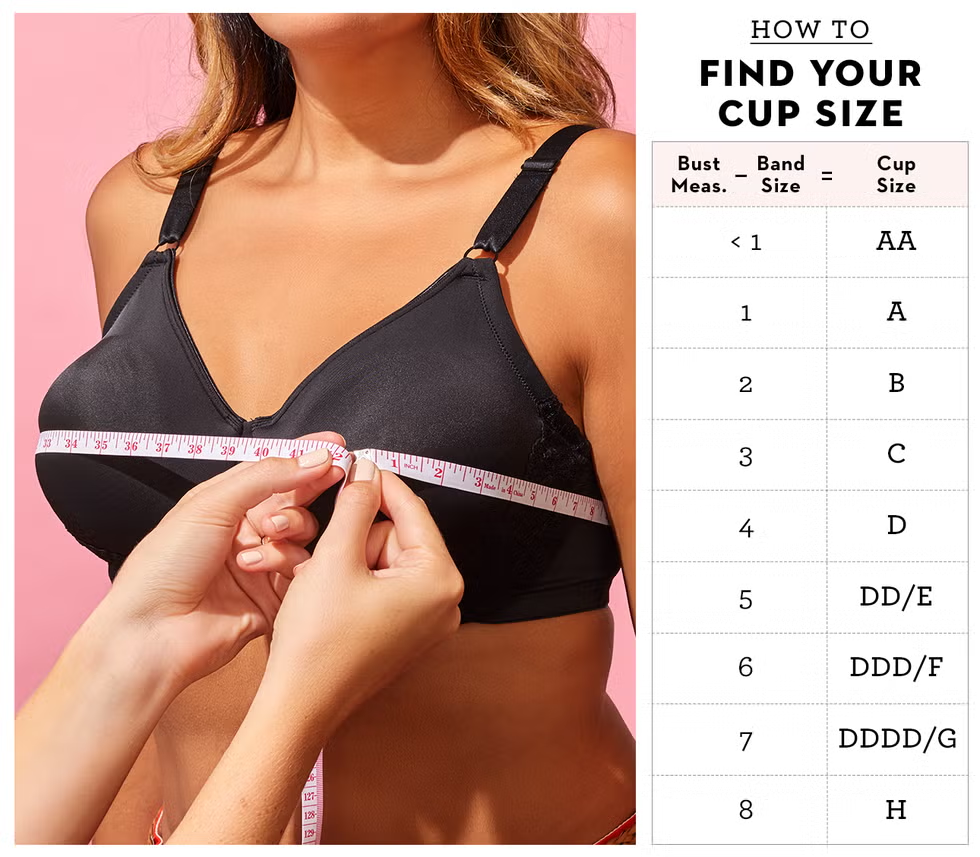
How to know if your bra fits correctly
Acing the right fit should look and feel like this:
- The band sits level all the way around your ribcage without riding up, constricting or squeezing.
- The center of the bra lays completely flat against the breastbone. That center piece between the cups is called the gore, and it shouldn't hover above the chest.
- The straps fit snugly without digging in. They should be adjusted to fit tightly enough for support, but not so tight that they dig in. Indentations or tired shoulders are a sign they're too tight.
- The cups don't gape or dig into the breasts, even when you move around. Be sure to walk, dance and wiggle around a bit to see how your breasts settle into the cups, and check both the sides and the front for potential spillage.
- The bra stays in place when you raise your arms. If the bra doesn't budge, then you have found a good fit for you.
What about breast shape?
Just because you've found your correct bra size (yay!) doesn't mean your work is done (sorry!). If you're not finding the perfect fit even after measuring yourself, you might be missing an important piece of context: your breast shape. Even if you’re wearing the ‘correct’ size, it might be that you’re wearing the wrong bra for your shape.
Fit is dictated as much by size as it is by breast shape, so you shouldn't be afraid to try additional sizes from various brands to find the bra that looks best and feels the most comfortable.
Here are some tips to ID your breast shape:
- Round breasts carry fullness all over. For full breasts, our experts recommend triangle or plunge bras that hug breasts without digging in.
- Teardrop breasts mostly carry fullness on the bottom. Try sweetheart demi silhouettes or fabric overlays that keep cups laying flat.
- Compact breasts sit high, and you might find that bras sit away from your body or that lace or fabric doesn’t lie flat. Shop for stretch fabrics or bras with contoured padding.
- Wide-set breasts carry fullness on the sides. Look for bras with gently curving underwires and generously spaced gores (the center part of the bra between cups).
- Asymmetric breasts are different sizes. Look for stretchy, shallow cups or contour styles sized to the larger breast. (Hint: Always shop for the larger breast to avoid telltale spillover.) You can also shop for bras with removable padding to compensate for the smaller side.
What is a bra "sister size"?
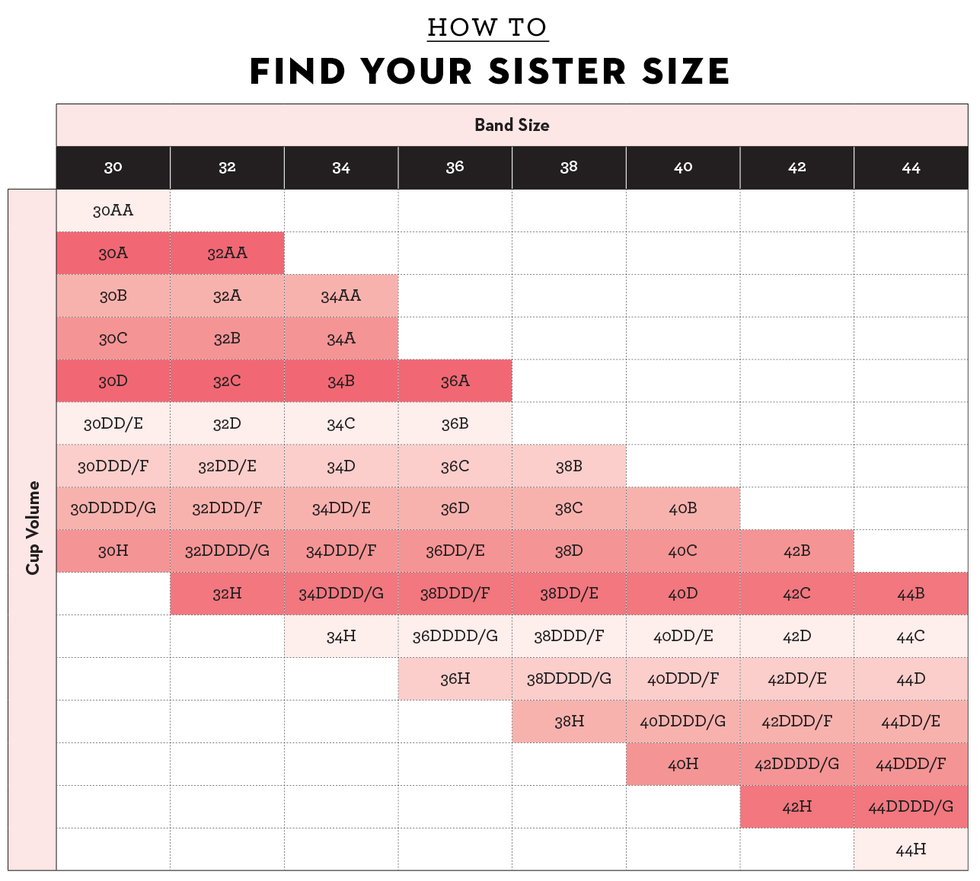
If you've measured meticulously, shopped for your breast shape and your bra still isn't fitting perfectly, you might need to shift your sizing a bit. If you try on a bra and the cups fit but the band is too tight, you can't just go up a band size: "You’ll actually end up with larger cups if you do this," Seymour explains. "Choose a sister size instead with a larger band for a better fit."
"A sister size refers to a bra size that has the same cup capacity with a different band size," says Seymour. "You should opt for a sister size when the cups fit but the band doesn’t," she advises.
The below chart makes easy work of finding your sister size:
How to make your bras last as long as possible
- Wash your bra only every few wears. "The more you wear and wash your bra, the faster it'll lose its elasticity," says Lexie Sachs, textiles expert and executive director of strategy and operations at the Good Housekeeping Institute. "You need that stretch to give you support."
- Keep a few bras in regular rotation. "Another way to maintain your bras is to have a regular rotation of pieces to wear throughout the week," says Dr. Sapna Palep, Co-CEO of Journelle. "Wearing the same bra multiple days in a row can stretch out the fabric and lace leading to faster wear and tear, requiring faster replacement."
- Start wearing the bra on the loosest band hook. "That way, you can tighten it as the band naturally stretches over time," says Ra’el Cohen, co-founder and chief creative officer at lingerie brand ThirdLove.
Emma Seymour (she/her) is the associate director of the Good Housekeeping Institute's Textiles, Paper and Apparel Lab, where she has led testing for luggage, pillows, towels, tampons and more since 2018. She graduated from Cornell University with a bachelor of science in fiber science and apparel design and a minor in gerontology, completing research in the Body Scanner Lab on optimizing activewear for athletic performance.