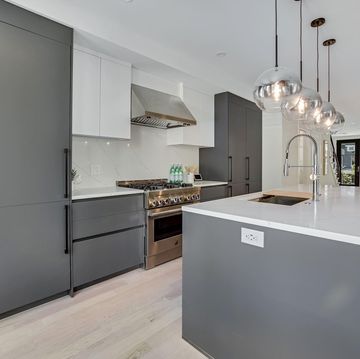
If you’re planning a kitchen remodel, you’ve no doubt come across quartz as an option for the countertops. Over the last two decades, the engineered stone product has become the most popular countertop material in the country, thanks to its design versatility, durability, and ease of maintenance. So why is California moving to ban its production?
What the ban means
The reason for California’s potential ban concerns quartz’s main ingredient: crystalline silica. During the fabrication and installation process as slabs are cut to size, the mineral can get released as dust into the air, unless workers follow safe practices, like using a wet blade and ensuring adequate ventilation. Airborne particles can then get lodged into the lungs, forming scar tissue and leading to silicosis, a chronic and incurable lung disease. It’s important to note that once quartz countertops are installed in a home, there are no longer any safety concerns related to silica dust.
Though the California ban still needs to be voted on before it takes effect, designers nationwide are already sourcing alternative materials for remodeling projects. If you’re about to embark on a kitchen makeover of your own, you might be doing the same.
The good news out of the Good Housekeeping Home Improvement & Outdoor Lab is that our experts have already tested several silica-free quartz countertops, and they’ve all aced our tough performance tests.
Silica-free quartz alternatives

Neolith, a 2025 GH Home Reno Award winner, was the first silica-free quartz countertop to pass through out Lab. As part of the evaluation, our experts reviewed independent testing from Neolith to confirm the silica-free formulation of the product. We also verified third-party safety and environmental certifications from various organizations, including Greenguard and the International Organization for Standardization.
As for Neolith’s performance, the removal of silica had little impact on its ability to repel stains and it also resisted heat and scratches, though our pros still recommend the use of cutting boards and trivets.
Another option is Caesarstone’s ICON countertop, which rolled out in 2025 and later took home a 2026 GH Kitchen Award, on the strength of its exceptional stain, scratch, and heat resistance in our tests. It’s more design-diverse than the Neolith, with a dozen compelling colors, ranging from sage green to various marble-inspired Calacattas.

Natural considerations
Outside of quartz, there are plenty of countertop options that deliver the same combination of beauty and low maintenance. Porcelain is a favorite with our design experts and engineers. Caesarstone’s Porcelain did a superb job fending off tough stains in our tests, and it can even be used outside, given its resistance to UV and temperature extremes.

Of course, you can also go for natural stone countertops, including granite, marble, and quartzite (which sounds like quartz, but consists entirely of metamorphic rock mined from the earth). Pricing is commensurate with premium quartz, ranging from $50 to $130 per square foot; see our countertop buying guide for more specifics.
You’ll have to be more mindful with the care and maintenance with natural stone surfaces, especially marble, given its highly porous composition. But you can’t beat their durability, nor the one-of-a-kind colors and patterns, which only mother nature can produce.
Having written thousands of product reviews and how-to articles on all aspects of home ownership, from routine maintenance to major renovations, Dan (he/him) brings more than 20 years of industry experience to his role as the director of the Home Improvement & Outdoor Lab at the Good Housekeeping Institute. A one-time roofer and a serial remodeler, Dan can often be found keeping house at his restored Brooklyn brownstone, where he lives with his wife and kids.