5 Best Coolers Out of the 85+ We’ve Tested
Hard and soft options for camping, entertaining, and chilling out.
 Tested by Nicole PapantoniouKitchen Appliances Lab Director

We've been independently researching and testing products for over 120 years. If you buy through our links, we may earn a commission. Learn more about our review process.
A cooler’s real test begins after the first few hours—when the ice starts to melt and everyone’s reaching for another drink. The best coolers keep food and drinks cold through backyard parties, beach days, tailgates, and camping trips, without making you constantly refresh the ice.
Our top picks:
- Best overall: YETI Roadie 60 Wheeled Cooler
- Best value: Arctic Zone Titan Deep Freeze
- Best small: Polar Bear Coolers Topper 20
Coolers come in all shapes and sizes, from roomy hard-sided models and wheeled coolers to soft-sided totes, backpacks, and compact car-friendly options. To find the best ones, experts in the Good Housekeeping Institute Kitchen & Cooking Lab have tested more than 85 coolers over the past decade. In our latest side-by-side test, our top pick, the YETI Roadie 60, stood out for its excellent temperature retention, easy maneuverability, and spacious, easy-to-clean interior, which holds up to 95 cans.

Pros
- Excellent ice and temperature retention
- Large wheels and extendable handle make it easy to maneuver
- Smaller footprint than many comparably-sized coolers

Cons
- Fewer accessories than other coolers

YETI coolers have consistently performed well in our Lab tests, and this 60-quart wheeled model is no exception. We love that, despite its large capacity, the Roadie is taller and narrower, so it has a smaller footprint than many shorter, wider wheeled coolers. It also is designed with a back-mounted handle and wheels, which create a slimmer profile and leave more room inside. The wide, level interior was easy to pack and clean, and the cooler excelled at temperature retention.
The Roadie was easy to pull and push over various surfaces, even when fully loaded and weighing more than 100 pounds. Its long, extendable handle and large, sturdy wheels made maneuvering a breeze.
The sleek cooler comes in four classic colors and includes a basket for keeping dry foods above the ice. However, it comes with fewer accessories (just a basket for dry goods) than other models we tested.
| Style | Hard cooler with wheels |
| Capacity | 60 qt. |
| Dimensions | 23.7" x 20" x 20.5" |
| Can capacity | 95 |

Pros
- Easy to clean, thanks to removable hard liner
- Bungee cords on top to help secure loose items
- Several easy-access outside pockets
Cons
- Doesn't come with a user manual
- After two days, 90% of ice melted in testing
The Arctic Zone Titan Deep Freeze is a small soft cooler with a hard interior—yes, you read that right: It's a lightweight model yet still holds its shape, and it had solid temperature control in our tests, although after two days, 90% of the ice had melted. It can hold up to 48 cans without ice, and it weighs about 44 pounds when fully packed with just cans. The hard liner is removable for easy cleaning.
The zipper-free design offers easy access and opens and closes using a Velcro-style hook-and-loop connection. It's equipped with a strap for easy carrying, as well as two handles on either side—helpful if you want two people to carry it when it's full. There's no user manual included, but additional features include a perforated tray that spans the length of the cooler to keep some items separated, several exterior pockets, and bungees on top to help control loose items like napkins.
| Style | Soft cooler with hard interior |
| Capacity | 20 qt. |
| Dimensions | 20" x 13" x 12.5" |
| Can capacity | 48 |

Pros
- Strong ice retention for soft cooler
- Convenient to transport using built-in top handle
- Easy to clean
- Zipper comes with lubricant to help maintain operation
Cons
- Slight odor after cleaning
- Detachable shoulder strap wasn't very comfortable during testing
Of all the soft coolers we tested, this one from Polar Bear Coolers performed the best. It even performed just as well as some of the hard coolers we tested, which typically outperform soft coolers. When filled with cans and no ice, its maximum weight is less than 30 pounds. The top handle (hence the name Topper) makes it relatively easy to carry; plus, it comes with a detachable shoulder strap, though we didn't find it that comfortable.
We appreciate the included instructions that describe how to prep the cooler and subsequently care for it. And the zipper comes with lubricant to help maintain smooth opening and closing. It's radio-frequency–welded (a.k.a. the plastic pieces are essentially melted together to create a better seal), which helps prevent leaks inside and out, and it even floats if you need it to. Although we noticed a slight odor after cleaning, we found the cleanup process to be simple.
| Style | Soft cooler |
| Capacity | 8 qt. |
| Dimensions | 14" x 10.5" x 13" |
| Can capacity | 30 |

Pros
- Built-in removable beverage tank with tap
- Large capacity for camping, tailgating, and entertaining
- Comfortable padded handles
Cons
- Weighs 44 lbs empty so will be heavier when full
- Slightly harder to push forward
The BrüTank is best for outdoor gatherings where its built-in 2.8-gallon beverage tank and tap make it easy to serve drinks without opening the cooler. It comes in nine colors and three sizes—20, 35, and 55 quarts.
It also features a foam seat top, a bottle opener, and an interior basket. Although the cooler can hold up to 80 cans, that capacity requires removing both the basket and tank.
The BrüTank was one of our top performers in our temperature retention tests. Its side handle feels sturdy and durable, even when the cooler is full, and the padded handles are comfortable to grip. That said, even empty, it’s heavy at 44 pounds, and we found it slightly harder to push forward.
READ OUR FULL REVIEW: BrüMate BrüTank
| Style | Hard cooler with wheels |
| Capacity | 55 qt. |
| Dimensions | 19.5" x 32.5" x 19.5" |
| Can capacity | 80 |
Pros
- Rotomolded so it's strong and durable
- Great temperature retention
- Food bin held with rubber hooks to keep food out of ice
- Retained a lot of ice after two days
Cons
- Heavy—it can weigh up to 110 lbs when full
- No wheels so it will need to be carried (preferably by two people) or stay in one place
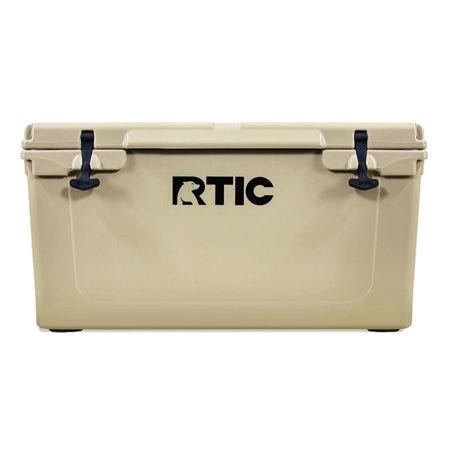
This cooler is rotomolded, meaning it’s made from a single piece of material, making it strong and durable. It can hold up to 64 cans with ice and comes with a food bin that latches with rubber hooks, which is key when you're camping and cooking in the wilderness, so you can keep your dry goods out of the ice in the bottom of the cooler.
It's thick with large handles for carrying. However, we recommend that two people carry it together when moving it at your campsite—or that you leave it in your car, since it doesn't have wheels and can weigh around 110 pounds when filled to its maximum capacity of cans, according to testing.
In our tests, it had great temperature retention, and plenty of ice was left over after 36 hours. Our testers also liked that it has two drains that allow you to release melted ice from either side, depending on how the cooler is sloped and where it's placed.
| Style | Hard cooler |
| Capacity | 65 qt |
| Dimensions | 32.52" x 19.21" x 18.03" |
| Can capacity | 64 |
Other coolers we tested

- Coleman Snap N Go: We’re currently testing this hard-sided 45-quart cooler that folds to one-third of its size for easy storage.
- Igloo Trailmate Journey Cooler: Igloo’s 70-quart cooler was one of the easiest to move when full. It kept temperatures impressively stable in testing, rising just over 2°F after 72 hours. However, it lacks a lock, so contents may spill if the cooler tips over, and it’s on the bulkier side.
- Ninja FrostVault Wheeled Cooler with DryZone: The wheeled Ninja FrostVault stands out for its insulated dry-zone drawer, which keeps food cool without ice. It delivered excellent performance in testing, but its large, heavy design requires extra storage space, and some users may prefer a cooler with more room in the main compartment instead of a dedicated dry-storage area.
- Rovr RollR 30: This 60-quart wheeled cooler has large wheels, a folding handle, and secure rubber latches. It maintained 35°F for 36 hours in testing and holds up to 65 cans. However, the placement of the drain plug makes it a little difficult to empty.
- RTIC Ultra-Light Hard Cooler: Though this cooler doesn’t have wheels (a dealbreaker for some), it weighs just 14.7 pounds, lighter than most rotomolded coolers and easier for one person to carry. It can hold up to 48 cans and double as a bench, stepstool, or tabletop.
- YETI Tundra Haul: This durable wheeled cooler holds 83 cans without ice and features easy-to-use rubber latches, an oversize folding handle, and a food crate. It maintained an impressive 33°F for 36 hours in testing, though its wheels take up interior space.
How we test coolers

The Good Housekeeping Institute Kitchen & Cooking Lab tests coolers by recording how long each model stays cold in a controlled setting that mimics real-life use.
In our most recent side-by-side cooler test, we evaluated 22 coolers and Lab-tested 15 of them. For each cooler, we assessed ease of loading and unloading, cleaning, and transporting. We also evaluated the helpfulness of the user guide, if one was included.
Overall, we collected more than 1,800 data points to determine which coolers would best withstand a typical day of use (and longer).

✔️ Temperature retention test: We filled each of the 15 tested coolers with a comparable ratio of one-third cans to two-thirds ice. We then placed a thermocouple—a highly sensitive scientific thermometer—inside one soda can in each cooler. The thermocouples were connected to a data logger that recorded temperatures every 15 minutes for 36 hours.

From there, we assessed each cooler's ability to maintain temperature at 12 hours and 36 hours. We also used this test to determine how easy the coolers were to pack.
✔️ Portability and capacity: Once every cooler was completely loaded, we carried the coolers around to see which were the easiest to travel with.

We weighed the coolers to determine how heavy they were after being filled up to their capacity with cans and ice.
✔️ Cleanability: After unpacking the coolers and assessing their drain spouts, we tested their cleanability and ability to resist odor by making a mess: We spilled soda in each cooler, tossed in half an onion, and let the mixture sit for a day. Then we washed the coolers with soap and water to see how well they cleaned up and if they still smelled like onion.
Which cooler holds ice the longest?

According to our testing, the RTIC 65-Quart Hard Cooler held the most ice after 36 hours. It had some water, but the ice probably could have lasted another day or two with what was left.
However, most of our picks retained a good amount of ice. If this is important to you, we recommend purchasing a hard cooler, which retained ice the best in our tests. If you prefer soft-sided, we found that the Polar Bear Coolers Topper 20 retained ice longer than any other soft cooler we tested.
What to look for when shopping for the best coolers

Keep these pointers in mind as you start to narrow down your search for the best cooler for your needs:
✔️ Type: The best cooler for you depends on how you plan to use it. Here’s a quick guide:
- Soft cooler: These are ideal for day trips, like a small, leisurely picnic or a day at the beach. Soft coolers are good to have on long drives as well. Most models are made of easy-to-clean shells and lined with insulating nylon for food safety, plus they come with handles for easy carrying. They're designed to keep food cold for up to one day.
- Backpack cooler: If you’re going on a long hike or kayak ride, backpack coolers are handy. They help keep your hands free to hold a walking stick or paddle, and they can usually carry other equipment as needed, such as water bottles or sunscreen. These coolers aren’t designed to hold many items, but they’re great for keeping your drinks and a sandwich or two cold.
- Cooler tote: Cooler totes are a convenient middle ground between an insulated lunch bag and a bulky hard-sided cooler: lightweight, flexible, and easy to carry, with enough space for meals, snacks, and drinks. However, they typically don’t keep food cold as long as hard-sided coolers, and some can be difficult to load or close.
- Hard cooler: Ideal for storing in your car or trailer while camping or setting out on your deck for easy access while you barbecue, hard coolers offer good ice retention and come in various capacities. They're generally made of durable double-walled plastic and/or foam insulation and are designed to keep contents cold for days. Keep in mind that a large model will be very heavy once filled and will need to stay in place or be moved by two people.
- Hard cooler with wheels: A wheeled cooler makes transportation easy. Whether you’re walking down to the beach or going on a camping trip, you don’t have to worry about hurting your back or finding a friend to help you carry it. Since coolers with wheels are often made out of a hard material, they retain ice and temperature well. One downside is that some designs can take up storage space inside the cooler, making them a little harder to pack.
✔️ Capacity: Coolers are available in a range of sizes, from a 5-quart cooler to carry your lunch to a 125-quart cooler that's large enough to hold more than 200 cans. Because a large-capacity cooler can get quite heavy, consider buying one on wheels—or even two smaller coolers (one for drinks and one for food) for easier transport.
✔️ Portability: These days, cooler companies are starting to attach wheels to their hard coolers. This allows individuals to take these big, heavy coolers and maneuver them easily and safely. Look for soft coolers with padded shoulder straps or backpack-style attachments, both of which can make carrying easier.
✔️ Construction: If you're a more experienced cooler shopper or someone who's really done their homework, you've likely seen the term "rotomolded," which means a hard cooler has been built from one continuous piece of plastic. This type of construction makes it more durable, with fewer places for the cooler to potentially leak over time. When shopping for soft coolers, look for watertight seals around the zippers.
✔️ Accessories: Many large hard coolers come equipped with dry bins for keeping goods dry and away from ice. Other features to look for include dividers that work within the ice to create individual sections, drink holders on the lid, umbrella holders, and can openers. For soft coolers, we like to have short handles and a long strap for carrying options, plus pockets.
Why trust Good Housekeeping?
Nicole Papantoniou runs the Good Housekeeping Institute Kitchen & Cooking Lab, where she oversees all content and testing related to kitchen and cooking appliances, tools, and gear, including this cooler test. Papantoniou is constantly testing new coolers in real-life situations, whether she's at the beach or in her backyard (and also probably testing grills at the same time).
Alec Scherma is the test engineer at the Good Housekeeping Institute, where he tests products across categories, including home and tech. He has conducted evaluations and testing on more than 35 coolers, buying and packing hundreds of cans of soda, and weighing and carrying each cooler.
Nicole (she/her) is the senior director of the Good Housekeeping Institute Kitchen & Cooking Lab. She oversees all content and testing related to kitchen products, food, and recipes. She has worked at GH since 2019, and is a trained cook, published recipe developer, and seasoned product tester with nearly 15 years of experience. She has worked in test kitchens for national magazines and kitchen appliances brands, where she also helped develop products for the home cook. She earned a degree in journalism from SUNY New Paltz, graduated with a Grand Diplome in Classic Culinary Arts from the French Culinary Institute, and studied culinary nutrition at the Natural Gourmet Institute (both now part of the Institute of Culinary Education in New York City.)
Readers Also Read

Jennifer Aniston's Go-To Body Cream Is on Sale

5 Best Air Fryers

Read an Excerpt of ‘Whistler’ by Ann Patchett

The 5 Best Supplements to Take


