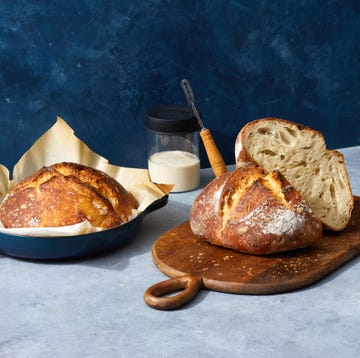
I’ve been baking sourdough for over a decade after inheriting a healthy starter from my dad, who was an early adopter of the home bakery movement. Though my folding, shaping, and scoring have improved over the years, one part of sourdough that never seems to get easier—or less messy—is maintaining the starter. Even worse is realizing I forgot a feed before I intended to bake.
That’s why, when the Sourdough Sidekick came on the market, which promised to take the legwork and guesswork out of maintaining a healthy starter, I was eager to give it a try.


What is the Sourdough Sidekick?
The Sidekick is a small countertop appliance about the size of a compact drip coffee maker that FirstBuild created and fine-tuned with help from King Arthur Baking Company.
It has a plastic water reservoir on the back, a flour hopper on top, and a glass starter crock with measurement markings. The machine comes with a detachable mixing paddle and a metal lid for the crock, which stores the starter in the fridge between bakes. All removable components are top-rack dishwasher-safe.

Pros
- Automatically tracks your feeding schedule
- Works with your preferred water and flour ratios
- Dishwasher-safe parts are easy to clean
Cons
- Small water and flour reservoirs may not support big-batch baking
- Requires countertop space
How does it work?
The Sidekick has a digital screen, a dial, and four buttons. The controls are clear and easy to understand. Using them, you can choose exactly how you want your starter fed using one of three modes:
- “Auto” lets you dial in how much starter you need to bake and exactly when you’ll use it over the next week, down to the minute. After adding seed starter, which can be as little as 15 grams, or about 2 tablespoons, the machine mixes and feeds at regular intervals to produce your desired amount. This mode removes the messy work of discarding starter and gives you peace of mind that you’ll have ripe starter just in time to start baking.
- The “Ratio” mode is great for experienced bakers who have a preferred starter-to-flour-to-water ratio. You select your ratio (for example, 1:1:1 for equal parts flour, water, and starter, or 1:2:2 for a slower-rising starter) and how often you want to feed. The machine tells you when it’s time to bake or discard.
- On “Custom” mode, you can experiment with different amounts of seed starter, feeding amounts, and frequency. This is great for bakers who like full control and precision over their bakes.

How the Sourdough Sidekick performed
I set up the Sidekick in “Auto” mode and instructed it to produce 200 grams of starter by 6 a.m. three days later. During that time, the machine (seemingly) randomly came to life, feeding and mixing my starter several times a day. The display counted down to my “goal” day.
Once the display read “Ready,” I had a thick, airy 200 grams of healthy starter in the crock. I got to work on my loaf, and 24 hours later, I was pulling a beautifully shaped loaf from the oven.
My starter looked, felt, and seemed to work just the same as when I was feeding and discarding on my own, but I’d happily skipped the hassle and mess of maintaining it. Not to mention, I’d cleared up a lot of mental space previously dedicated to timing, ratios, and planning my next loaf, without sacrificing the part I enjoy: the process of making and baking.
I’ve also used the machine to help maintain my starter when I travel or want to take a break for a week or more. The “Ratio” mode kept my starter at the perfect consistency with 24-hour feeds; I just had to discard every couple of days.
One note: If you bake in big batches or use recipes with a large amount of starter, the jar and reservoirs for water and flour may not be sufficient for you.
Bottom line: Is the Sourdough Sidekick worth it?
After testing the Sourdough Sidekick for six weeks and baking multiple boules, English muffins, granola, and more using the discard, I can confidently say it’s a great tool for both beginners and experienced bakers.
Unless you especially love the process of keeping a starter alive, the Sidekick is a helpful addition to any sourdough baker’s toolkit. I’ve baked more and had more fun experimenting with flavor additions, loaf shapes, and flours than before, and I’m excited to continue putting my healthy starter to new uses.
Why trust Good Housekeeping?
Lizzy Briskin is a contributing product analyst in the Good Housekeeping Institute Kitchen & Cooking Lab, where she tests everything from toasters to knife sets. She has a professional culinary degree and has been baking sourdough for over 10 years.