 Reviewed by

Jump to:
There are tons of benefits to fitting a daily walk into your day. Walking can help you live longer, lower stress and anxiety, and reduce your risk of dementia and cardiovascular disease. It can also be an effective way to burn calories and lose weight. We’ve compiled a simple guide to help you understand how many calories can be burned by walking.
"Walking is one of the fastest, easiest ways to burn calories, because you can squeeze it in any time, even inside your home," says Denise Austin, the famed fitness expert and author.
As is often the case when it comes to health metrics, there are a lot of factors to consider. Your weight, walking pace, and incline of your route can all play a role. To estimate the calorie burn for a variety of activities (including walking), check out this calculator from the American Council on Exercise, which takes your weight into account.
That said, if you don't want to do a detailed calculation, there is a general rule of thumb for the number of calories burned when walking. "A quick guesstimate of how many calories the average person burns is 100 calories per mile — and that's whether you're running a marathon or taking a nice leisurely stroll," says Timothy Burnett, Ph.D., a former instructor of kinesiology at Oregon State University Cascades.
We also want to note that weight loss, health and body image are complex subjects — before deciding to go on a diet or switch up your exercise, we invite you to gain a broader perspective by reading our exploration into the hazards of diet culture.
Below, learn more about how many calories are burned by walking and ways to increase the calorie burn on your daily walk.
Calories burned from walking
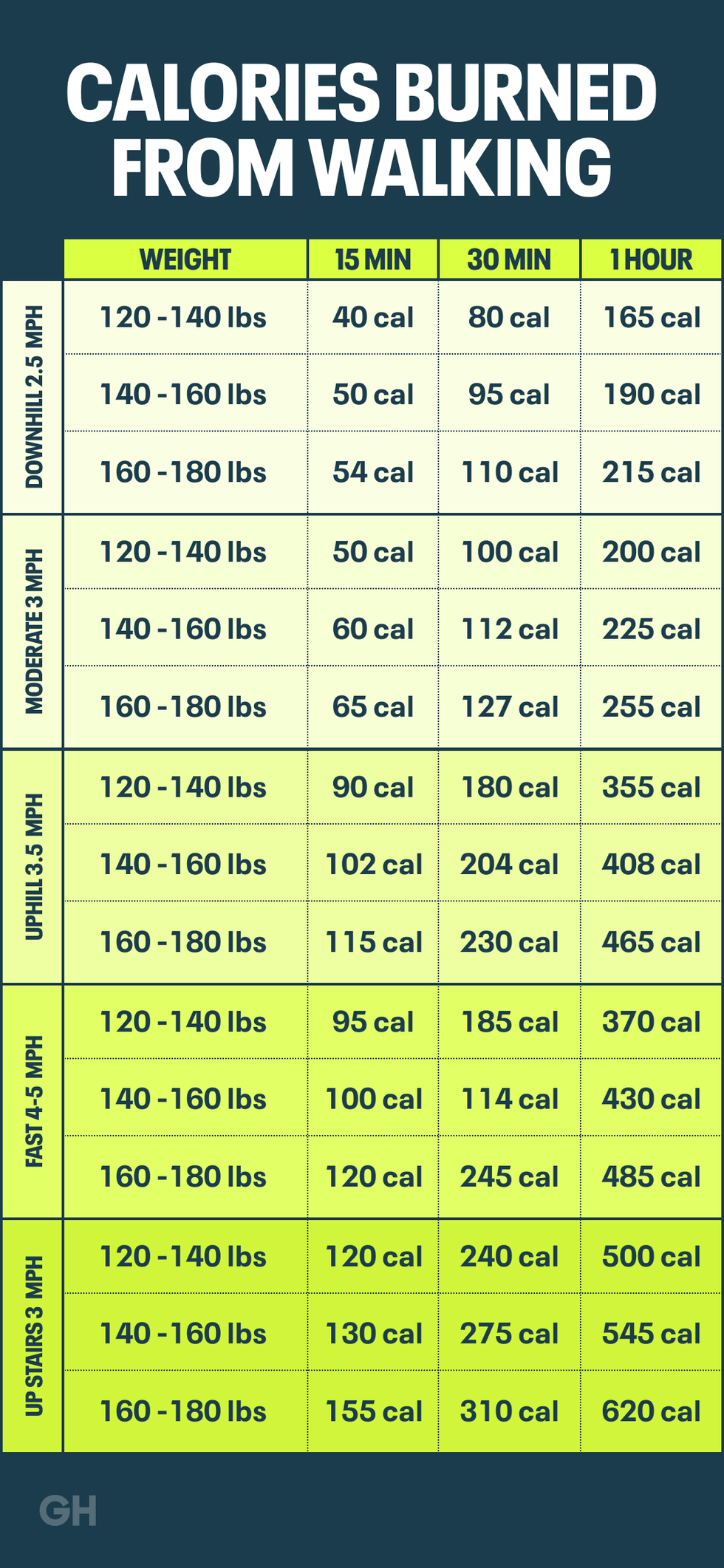
For People Who Weigh Between 120-140 Pounds
Walking at a Moderate Pace (3 mph)
- 15 minutes: 50 calories
- 30 minutes: 100 calories
- 1 hour: 200 calories
Walking at a Fast Pace (4-5 mph)
- 15 minutes: 95 calories
- 30 minutes: 185 calories
- 1 hour: 370 calories
Walking Uphill (3.5 mph)
- 15 minutes: 90 calories
- 30 minutes: 180 calories
- 1 hour: 355 calories
Walking Up Stairs (3 mph)
- 15 minutes: 120 calories
- 30 minutes: 240 calories
- 1 hour: 500 calories
Walking Downhill (2.5 mph)
- 15 minutes: 40 calories
- 30 minutes: 85 calories
- 1 hour: 165 calories
For People Who Weigh Between 140-160 Pounds
Walking at a Moderate Pace (3 mph)
- 15 minutes: 60 calories
- 30 minutes: 112 calories
- 1 hour: 225 calories
Walking at a Fast Pace (4-5 mph)
- 15 minutes: 100 calories
- 30 minutes: 214 calories
- 1 hour: 430 calories
Walking Uphill (3.5 mph)
- 15 minutes: 102 calories
- 30 minutes: 204 calories
- 1 hour: 408 calories
Walking Up Stairs (3 mph)
- 15 minutes: 130 calories
- 30 minutes: 275 calories
- 1 hour: 545 calories
Walking Downhill (2.5 mph)
- 15 minutes: 50 calories
- 30 minutes: 95 calories
- 1 hour: 190 calories
For People Who Weigh Between 160-180 Pounds
Walking at a Moderate Pace (3 mph)
- 15 minutes: 65 calories
- 30 minutes: 127 calories
- 1 hour: 255 calories
Walking at a Fast Pace (4-5 mph)
- 15 minutes: 120 calories
- 30 minutes: 245 calories
- 1 hour: 485 calories
Walking Uphill (3.5 mph)
- 15 minutes: 115 calories
- 30 minutes: 230 calories
- 1 hour: 465 calories
Walking Up Stairs (3 mph)
- 15 minutes: 155 calories
- 30 minutes: 310 calories
- 1 hour: 620 calories
Walking Downhill (2.5 mph)
- 15 minutes: 54 calories
- 30 minutes: 110 calories
- 1 hour: 215 calories
More FAQs
What's the best way to track calories burned?
There's always the old-fashioned way of pencil-and-paper math, but you can also invest in a fitness tracker. While this investment isn't necessary to get the most out of your walk, it may inspire you to keep moving.
How can you burn more calories by walking?
Once you get into a routine, and it becomes more natural to walk more, you can amp up your calorie burn with these strategies:
What are the other health benefits of walking?
Walking is one of the best activities for your health, head to toe. Here are five other benefits of walking to keep in mind:
Stefani (she/her) is a registered dietitian, a NASM-certified personal trainer and the director of the Good Housekeeping Institute Nutrition and Fitness Lab, where she oversees all nutrition and fitness-related content, testing and evaluation. She holds a master’s degree in clinical nutrition from New York University, as well as advanced certifications as a Women's Fitness Specialist and a Behavior Change Specialist. Stefani is dedicated to providing readers with evidence-based content to encourage informed food choices and healthy living. She is an avid CrossFitter and a passionate home cook who loves spending time with her big fit Greek family.


