
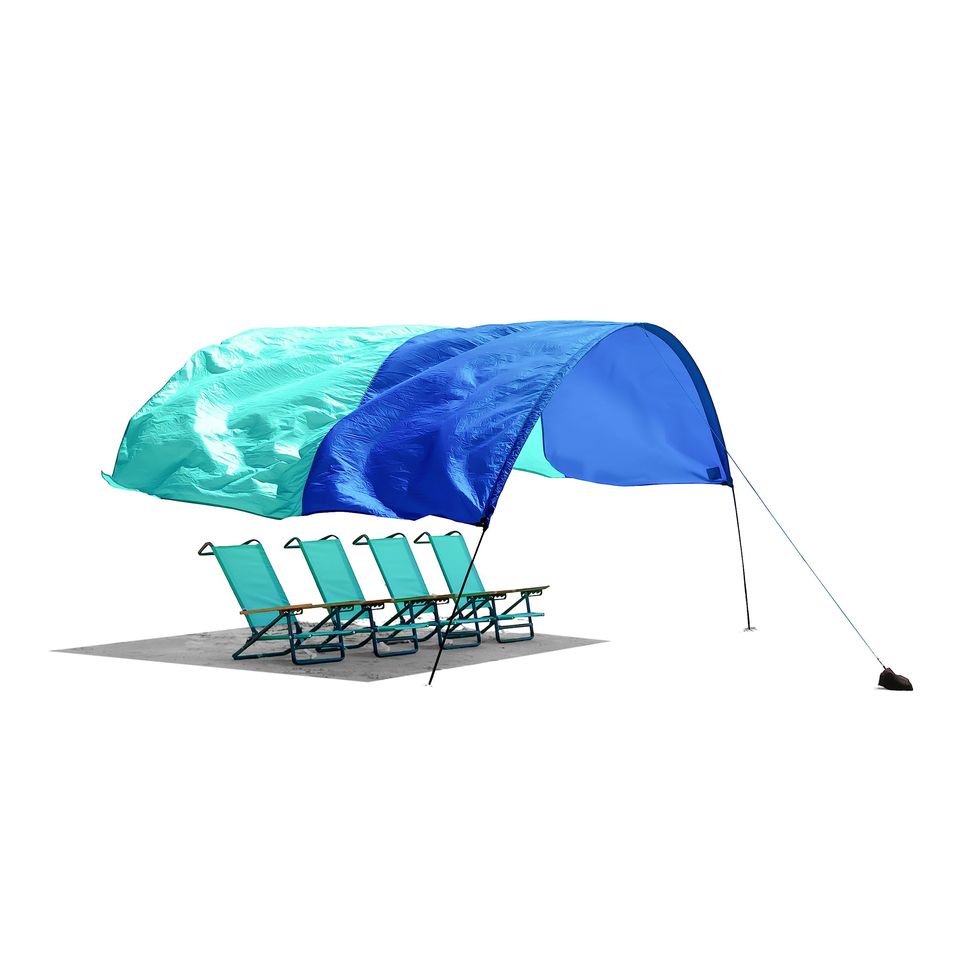
Lugging the beach chairs, cooler, and umbrella from the car to the beach can be exhausting. Luckily for all beachgoers (including myself!), setting up a spot for shade in the sand is easier than ever with the Shibumi Shade.
Pros
- Lightweight
- Easy to set up
- Large size provides up to 150 square feet of shade

Cons
- Needs wind to work properly
- Only one color option

| Weight | 4 lbs |
| UPF | 50+ |
| Materials | 40% recycled plastic and polyester canopy, aluminum poles |
| Fabric dimensions | 16' x 8' |
| Carry bag dimensions | 26" x 5" |
| Shade provided | 150 sq. ft. |
You may have noticed a few Shibumi Shades scattered along the shore the past few summers, flapping somewhat noisily in the wind. Their emergence as a must-have piece of beach gear made us want to put it to the test. When our experts in the Good Housekeeping Institute Textiles Lab tested the best beach tents, we named the Shibumi Shade as one of our top picks, but we wanted to go even deeper to share our thoughts on the wind-powered canopy.
For a more extensive Shibumi Shade review, Emma Seymour, Textiles Lab associate director, and Amanda Constantine, a reviews analyst in the Textiles Lab, brought the shade to the beach. They assessed the setup process, effectiveness, weight, and the ease of cleaning and packing up the beach shade.
So, what makes the Shibumi Shade better (or worse) than other options on the market? And more importantly, should you fork over nearly $300 for it? Here, we're laying all the details out in the open to help you decide if a Shibumi Shade is worth it.
What is the Shibumi Shade?
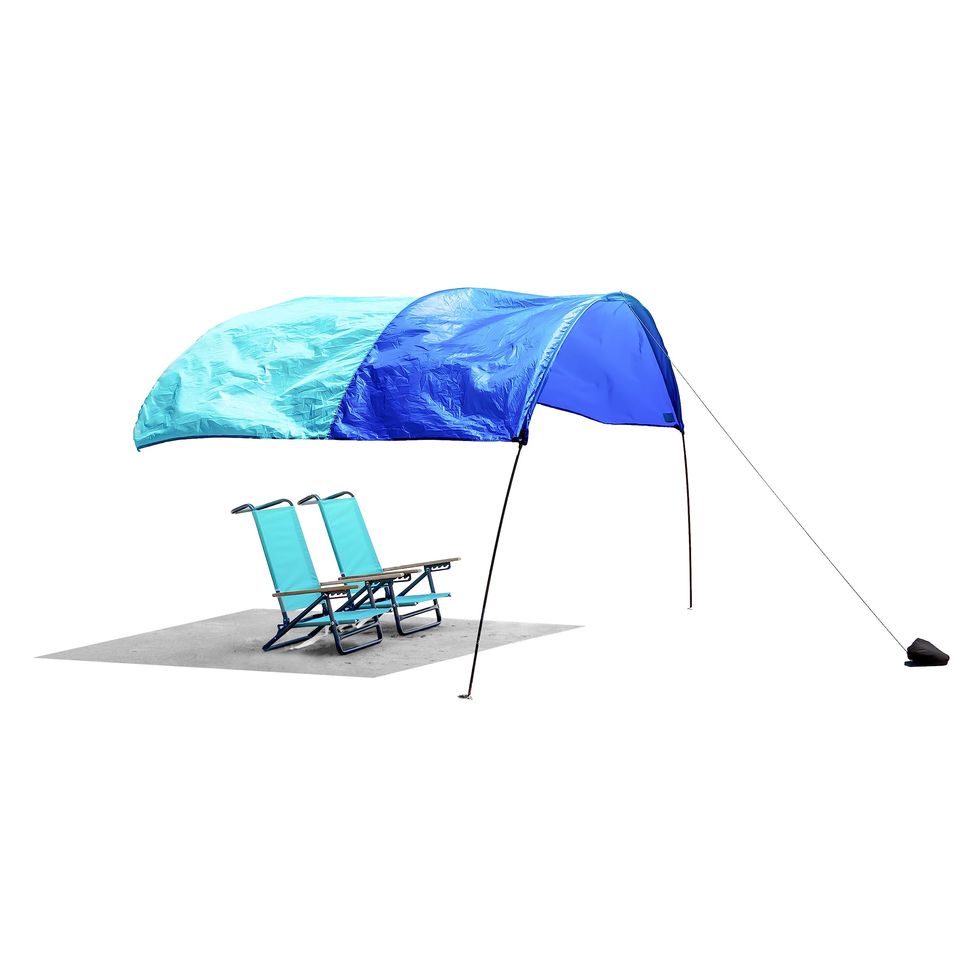
Here's the simple answer: The Shibumi Shade is a wind-powered shade that's light, easy to set up, and won't fly away in the wind. The shade uses the ocean breeze to keep the canopy fabric floating horizontally, creating a rectangular area of shade underneath it. With the Shibumi Shade, you won't have to worry about a strong gust of wind ripping it out of the sand and blowing your shade across the shore, but it needs at least 3 mph of wind to stay aloft.
Weight and size
The brand keeps it simple with two shade sizes, the Shibumi Shade and the Shibumi Shade Mini. The regular size is only 4 pounds and provides 150 square feet of shade. The fabric is UPF 50+, so it'll protect you from harmful UV rays (but that does not mean you should skimp on sunscreen), and it comfortably fits four to six people under it. The Mini provides enough shade for two people and weighs less than 2 pounds, so it's perfect for a beach date. Both are only available in the brand's iconic two-tone blue design.
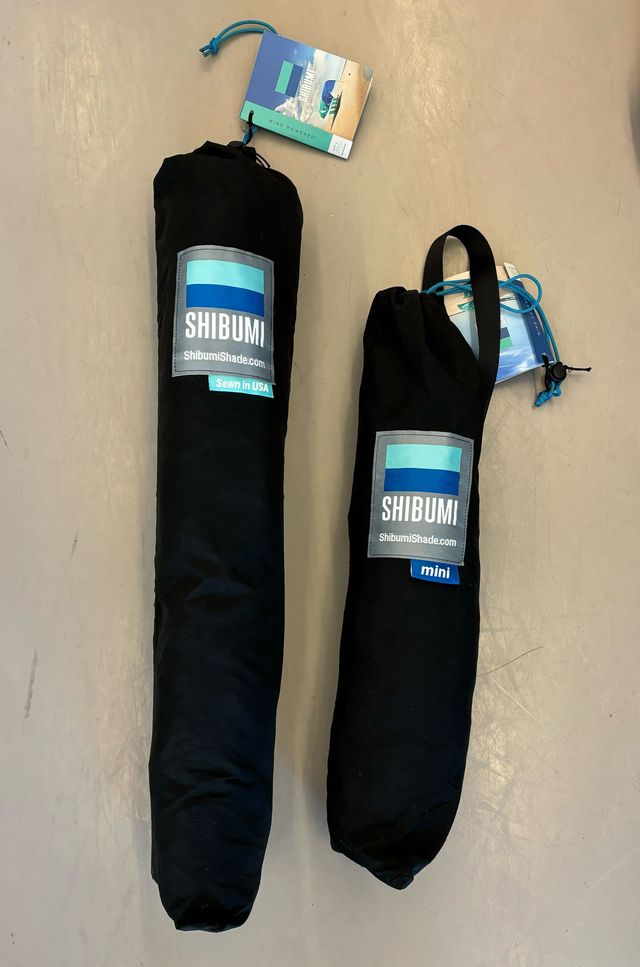
Each shade comes in a compact black bag. Swing it over your shoulder or stuff it in a larger tote bag—either way, Constantine called it "so lightweight." It's lighter and smaller than popular competitors. For example, a cabana from CoolCabanas weighs 12.5 pounds and is stored in a 3.5-foot-long bag.
Materials
The fabric of the Shibumi Shade is made from 40% recycled plastic bottles to make the REPREVE Our Ocean fiber. A spokesperson from the brand says, "These bottles are collected within 50 kilometers of coastlines in countries that lack formal waste or recycling systems." It's also made with a polyester canopy, the same material as most parachutes.
The poles are aluminum, which is a sturdy material that's flexible enough to bend but strong enough to stay put in the sand and handle the force of the wind. Online reviewers said the shade felt sturdy and durable, which our experts found to be true in their test once the poles were planted and the shade was weighed down.
The setup and cleanup process
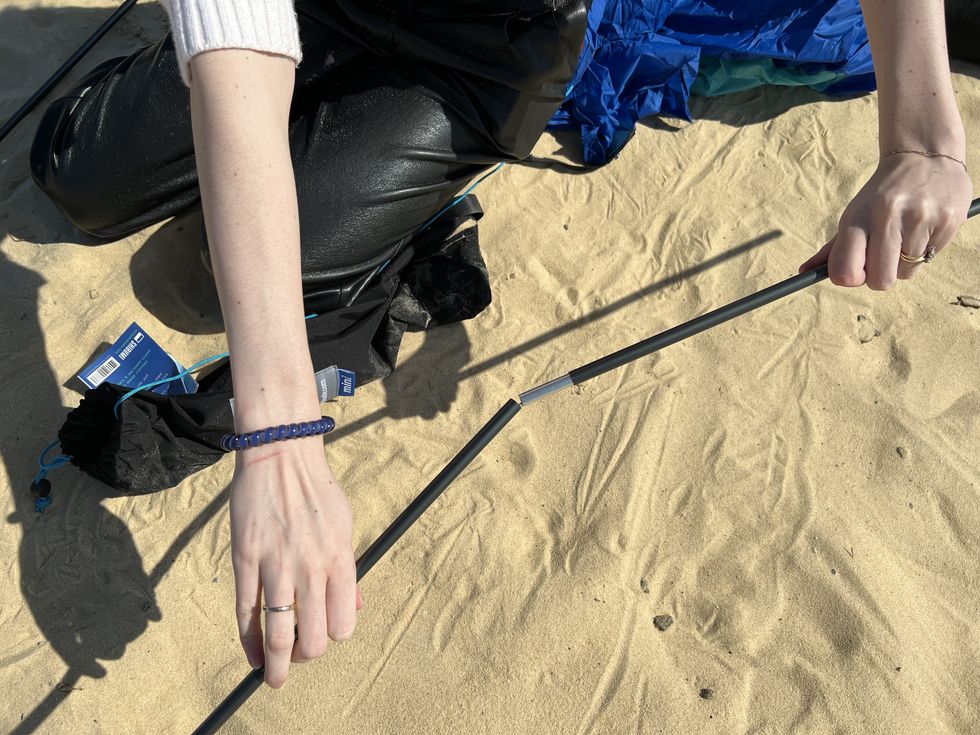
Perhaps the biggest perk customers love about the Shibumi Shade is how easy it is to set it up—and our experts agree. It took our pros less than 10 minutes to review the instructions and set up the shade, and Constantine was pleasantly surprised with how easy it was, calling it "a piece of cake."
Simply connect the poles, thread the long pole through the canopy slot, and push each end of the pole 6 inches into the sand. Fill the same bag it comes in with sand to create an anchor, then snap the straps shut to secure the shade to the poles. You must set it up so that the wind is blowing in the direction of the fabric to create the "floating" effect.
Constantine said, "It was simple to connect the poles, but watch out. The fully connected pole ends up being pretty long and could run into someone next to you at the beach while you’re setting up. The process took just a couple of minutes. After the pole was connected, the shade slid on without snagging or bunching." After this step, the fabric immediately caught the wind, but the job wasn't done quite yet.
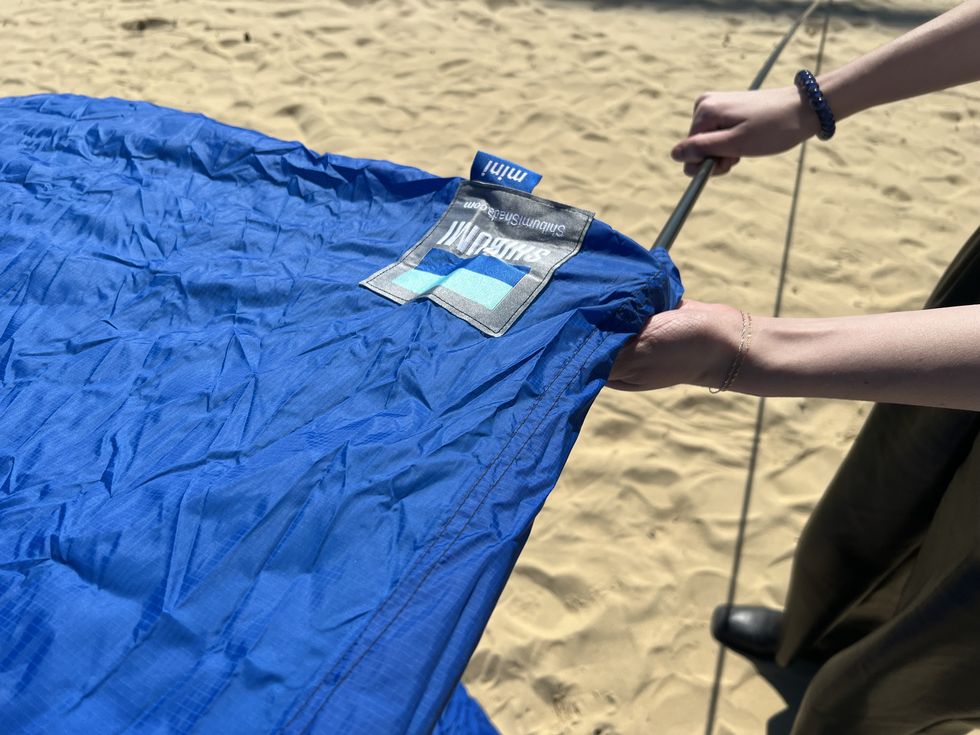
The most difficult part of setting up a traditional canopy is typically planting the poles deep enough into the sand, but Constantine says the Shibumi Shade did not require a ton of force, though "it didn’t feel super secure right away," she said. The duo "struggled a little bit" to stabilize the shade, but after filling the carrying case with sand, Constantine reported the canopy straightened itself out and stayed up.
Constantine and Seymour were impressed by how sturdy the Shibumi Shade felt once it was properly set up, and they were even more impressed by how easy it was to put it away at the end of the day. "Taking the shade down was even quicker than putting it up, and we didn’t have difficulty stuffing everything back inside the carrying case," said Constantine. However, using the carrying case as a sand-filled anchor has its drawbacks. "It is a bit messy having to fill the carrying case with sand and then emptying it at the end of the day. No matter how hard you try, you’ll definitely be taking some sand home with you," Constantine said.
Noise level
Though the wind-powered shade makes setup easier and prevents the canopy from flying away, the con is that the fabric makes noise as it flaps up and down in strong winds. The new-and-improved model is now "quieter" and "stronger," according to the brand, but we can't deny the fact that it is still a bit loud.
If you’re at a crowded beach, the sound will likely be drowned out by the noise of people enjoying themselves, children playing, and music blasting. If it’s a quiet beach with strict rules, you may still be able to get away with it because it's not an intentionally disruptive noise. Either way, it's something to be aware of so that you can use your best judgment.
Are Shibumi Shades banned anywhere?
A few beaches in the U.S. have banned the Shibumi Shade: Myrtle Beach, North Carolina; Horry County, South Carolina; Rehoboth, Delaware; Bethany Beach, Delaware; Long Beach Township, New Jersey; Beach Haven, New Jersey, and Manasquan, New Jersey.
The choice to ban the shades is unique to each beach and may be due to noise or size restrictions. According to local news from South Carolina, Myrtle Beach banned the beach shade due to fears of overcrowding and potential issues for lifeguards.
If a lifeguard or safety personnel asks you to take it down, it's best to follow the beach's rules. Otherwise, you're free to use the Shibumi Shade anywhere the wind takes you.
What if it's not windy enough?
The chances of the wind speed being below the needed 3 mph at the beach are pretty low. "Most beaches will have a sufficient breeze more than 90% of the time," according to the brand. When the wind speed is low, the material may falter and dip rather than remain horizontally stable, causing the area of shade to shift and shrink. This also means the Shibumi Shade may not be the best option at the park. Before heading to the beach, you can always check Windfinder.com (which also has an iOS and Android app) to find the wind speed and direction that day.
Bottom line: Is the Shibumi Shade worth it?
The Shibumi Shade has all the perks of an umbrella while removing almost all the downsides: It's effective, durable, user-friendly, and compact for storing. Constantine says it creates an area of shade "big enough for a couple of chairs or beach towels," so you can fit yourself and some friends under it. Throw in the fact that it's partially made from recycled materials, and you're looking at a product that's worth buying.
On the off chance that your Shibumi Shade breaks or rips, the brand offers one replacement shade and one pole set replacement if it occurs within three years of purchasing. And if you don’t love it, there's a one-year return policy.
The price is undeniably high—it's the second most expensive option on our beach tent roundup—but it’s a quality item with a one-of-a-kind design. There are no dupes; we've checked.
SHOP THE SHIBUMI SHADE ON AMAZON
SHOP THE SHIBUMI SHADE MINI ON AMAZON
Why trust Good Housekeeping?
Our experts from the Good Housekeeping Institute Textiles Lab brought the Shibumi Shade to the beach to test the product for themselves. Amanda Constantine, home and apparel reviews analyst, has evaluated and tested textiles, home products, clothing, and more for the GH Institute since 2022. She has a Master of Science in Consumer Sciences from The Ohio State University, a Bachelor of Science in Apparel Merchandising and Product Development from Bowling Green State University, and an Associate of Applied Science in Advertising and Marketing Communications from the Fashion Institute of Technology.
Emma Seymour, Textiles, Paper & Apparel Lab Associate Director, has been at Good Housekeeping for over five years, overseeing Lab and consumer tests for clothing, sheets, towels, and more. She has a degree in Fiber Science and Apparel Design from Cornell University, as well as extensive research experience and product quality assessment expertise.
This story was written by Isabella Cavallo, Editorial Commerce Editor at the GH Institute. She lives 25 minutes from the shore, prompting her to go as often as she can. Always on the lookout for products that require minimum input but give maximum output, Cavallo only brings the lightest, easiest items to the beach.
be


