The 6 Best Gas Ranges Right Now, According to a Trained Chef
From high-performance luxury ranges to affordable models that don’t sacrifice quality.
 Reviewed by Nicole PapantoniouKitchen Appliances Lab Director

We've been independently researching and testing products for over 120 years. If you buy through our links, we may earn a commission. Learn more about our review process.
As an analyst and trained chef in the Good Housekeeping Institute Kitchen & Cooking Lab, I often hear from devoted gas-range fans who insist they’d never cook on an electric or induction range. Gas ranges’ fast heating, precise control, and visible flame make them a favorite of home cooks and pros alike. After years of testing, I’ve found the best models balance burner power and versatility, heat quickly and evenly, and prioritize performance over flashy features. With so many options available, choosing can be tough—but my team and I have done the testing to make it easier.
Our top picks:
- Best Overall: LG Smart Slide-In Gas Range
- Best Value: Maytag Freestanding Gas Range
- Best Double Oven: Samsung Smart Freestanding Gas Range with Flex Duo
- Best Smart: GE Profile Smart Slide-In Gas Range
Over the past two decades, my Kitchen Lab team and I have tested nearly 100 ranges—including more than 50 gas and dual-fuel models—to identify the best gas ranges on the market. In our Lab, we test up to six ranges at a time, putting each through more than a dozen evaluations to assess performance and ease of use.
 Best Deal


Pros
- Extra features, including air fry and air sous vide
- Intuitive controls and display
- Burners heat evenly and quickly

Cons
- Connecting to LG ThinQ app took a few tries during testing

This 2026 Kitchen Award-winning 30-inch smart slide-in gas range from LG is feature-packed: It has a spacious convection oven with features like air fry and air sous vide, plus a window that lets you tap twice to see what's cooking inside without opening the door. The oven comes with two racks and a temperature probe that can be inserted into proteins to check for doneness.
This five-burner range includes a center griddle for flipping pancakes or burgers, along with a right-front power burner that delivers 18,500 BTUs for quickly boiling water.
This range has easy-to-navigate knobs and a digital display on a slanted panel. We also appreciate LG's optional "smart diagnosis" feature, which transmits data directly from your phone to LG's Customer Information Center for troubleshooting. However, it took a few attempts to connect to the LG ThinQ app during testing.
HOW IT PERFORMED IN OUR TESTS: We found that the balanced cooktop provided even heat distribution, boiled water quickly, and maintained a constant simmer. The oven delivered even heat distribution, baking cookies and cake beautifully. The self-clean function was also easy to use.

Pros
- Center burner for griddles and oversized pots
- Five different air-powered cooking functions
Cons
- Various functions on the model aren't intuitive to operate
This Maytag gas range offers the best value for its numerous features. The sleek fingerprint-resistant stainless steel range replaced a similar discontinued model that performed well in Lab testing. The stovetop features five burners, including a center burner that's perfect for oversized Dutch ovens or stovetop griddles and an 18,000 BTU power burner for boiling water.
The 5-cubic-foot-capacity oven with two oven racks also features new air-powered cooking functions that, according to the brand, use a third heating element to circulate air throughout the cavity. Functions not available on previous models include: no preheat air fry, air bake, air roast, air broil, and air reheat. I also love that there's a large oven drawer at the bottom for storing cookie sheets.
HOW IT PERFORMED IN OUR TESTS: I feel confident recommending this newer model by Maytag, given that the previous gas range produced consistent results in testing. Water stayed at a consistent simmer on the stovetop, and bread browned evenly in the oven.
After reading reviews of the current model, I noticed that many customers were unsure how to use all the new functions, so I look forward to testing this model myself and seeing how they perform.

Pros
- Oven can split into two
- Smart connectivity
- Intuitive controls
Cons
- Two compartments can’t be set to completely different temperatures
Samsung’s smart range has an oven with a ceramic divider that lets you switch from a large 6-cubic-foot single cavity to two smaller cavities. Being able to turn the oven into two smaller cavities is especially useful when you’re entertaining, since you can keep one dish cooking while another finishes, without constantly rearranging oven racks. If you’re baking both savory and sweet dishes at once, keeping them separate also helps prevent flavors from transferring.
This model comes with several accessories, including a griddle and an air-fry tray, to help you get the most out of the range. The removable nonstick griddle fits over the center burner and is ideal for pressing sandwiches, while the air fry basket can be used in the oven to promote even browning and crispiness when cooking vegetables.
HOW IT PERFORMED IN OUR TESTS: While we haven't Lab-tested this Samsung model yet, we've tested other Samsung ranges and have loved their easy-to-use, brightly lit control dials and panel. Keep in mind that because this is a faux double oven, online reviewers note that the two compartments can’t be set to completely different temperatures—they must be within 50 degrees of each other.
| Size | 30 in. |
| BTUs | 5,000–18,000 |
| Oven capacity | 6 cu. ft. |
| Burners | 5 |
Pros
- Even heat distribution in oven
- Boils water quickly
- Smart connectivity
Cons
- Stovetop needed extra cleaning attention in testing
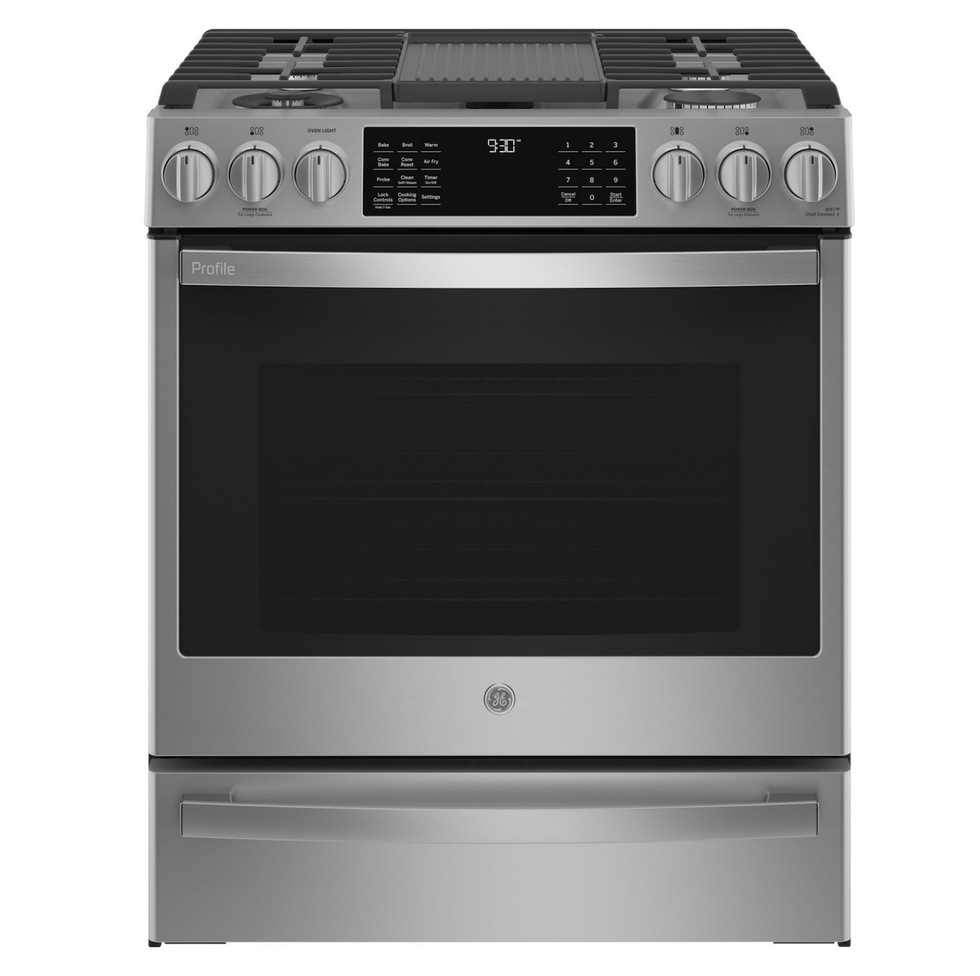
GE's SmartHQ Wi-Fi-based app allows for remote control, monitoring, and diagnostics, and is compatible with Alexa, Google Home, and ChefConnect (which can pair with a compatible hood or microwave). This sleek range pairs these smart features with a true convection oven. The oven also features settings like air fry and frozen pizza.
The cooktop's burners offer a variety of outputs, whether you need to boil water on the 21,000 BTU burner or simmer a delicate sauce on the 5,000 BTU burner. It also features a reversible center griddle for cooking pancakes that flips over to function as a grill pan for charring burgers.
HOW IT PERFORMED IN OUR TESTS: The stovetop received high scores for its very even heat distribution, in addition to its speedy water boiling time. It also had even oven heat distribution and broiled up a nicely browned steak. We also found that this model was very easy to use; the only thing that prevented it from achieving a perfect score was the need for extra care when cleaning the stovetop because of its grate configuration.
| Size | 30 in. |
| BTUs | 5,000–21,000 |
| Oven capacity | 5.6 cu. ft. |
| Burners | 5 |

Pros
- Easy-to-use control panel and intuitive interface
- Steam feature
- Beautiful design
Cons
- Can be tricky to clean
I love this Dacor 36-inch dual-fuel range's easy-to-use control panel and intuitive interface, large, easy-to-grab illuminated knobs, and three roll-out racks in the oven. It has a beautiful, sleek design and is low to the ground, with brass burners.
Its six gas burners deliver serious power, including a high-output burner rated at 22,000 BTUs. The electric oven offers air fry and steam-assist modes, which help keep proteins juicy on the inside while creating a crisp exterior through a combination of steam and dry heat.
HOW IT PERFORMED IN OUR TESTS: I tested an older version of this model, which excelled in our oven heat distribution tests, evenly toasting bread on both bake and broil settings. When testing the steam function, salmon skin got nice and crispy while remaining very moist.
I found that while the self-clean function was not very noisy or smelly, it didn't clean as well as I had hoped. Additionally, many small crevices and grooves make it challenging to clean thoroughly.
| Size | 36 in. |
| BTUs | 16,000–22,000 |
| Oven capacity | 6.3 cu. ft. |
| Burners | 6 |

Pros
- Innovative pizza mode
- Easy to navigate control panel
- Easy to monitor oven with bright oven light
Cons
- Oven drawer could be larger
Note: Frigidaire has voluntarily recalled this model and advises consumers not to use the oven until it has been repaired by an authorized service technician. You can learn more about the recall here
Want a pizza oven, but also need a new gas range? This innovative model from Frigidaire Gallery features Stone-Baked Pizza Mode, which replicates the high-heat environment of your favorite pizza joint. This setting heats the oven to 750°F, allowing you to cook a pizza quickly; in my testing, it took about three minutes.
The 30-inch range with two oven racks offers numerous oven settings beyond pizza mode, including air fry, slow cook, steam bake, steam roast, and air sous vide. The cooktop boasts five burners, with an optional griddle that can be placed in the center for making smash burgers.
HOW IT PERFORMED IN OUR TESTS: This is a sleek range that's highly versatile, far beyond just the pizza mode, with one of the best oven control panels I've used. On the cooktop, the largest burner brought 6 quarts of water to a boil in 25 minutes, which is faster than most gas and electric ranges I've tested, while the smallest burner maintained a steady simmer for an hour.
The oven heated evenly, and the broiler worked quickly. The pizza mode was speedy as well and delivered nicely charred results, similar to a standalone pizza oven. However, I wish the oven drawer were larger to hold more.
READ OUR FULL REVIEW: Frigidaire Gallery Gas Range with Pizza Mode

Features at a Glance
| Size | 30 in. |
| BTUs | 5,000–18,000 |
| Oven capacity | 6 cu. ft. |
| Burners | 5 |
How we test the best gas ranges

In the Good Housekeeping Institute Kitchen & Cooking Lab, our product analysts have tested almost 100 ranges in recent years, including more than 50 gas and dual-fuel models.
The models featured here were selected based on hands-on Lab testing of current models and prior test data from discontinued models from top-performing brands.

Our analysts continuously evaluate new ranges in the Kitchen & Cooking Lab, where we can test up to six models side-by-side at a time. After completing Lab tests, we also send select models to consumers’ homes for long-term, real-world use and feedback.
When we test side-by-side in the Lab, we perform the same test on all models simultaneously to compare their performance and use rigorous testing criteria to evaluate each model's ease of use.

✔️ Stovetop performance testing:
- Boiling water: We measure how quickly the largest burner brings water to a boil and whether it maintains a steady simmer.
- Simmer test: We assess whether the smallest burner can hold a consistent simmer for up to an hour without scorching.
- Heat distribution test: We coat a skillet with flour and heat it to evaluate how evenly it browns (pictured here).

✔️ Oven performance testing:
- Toast test: We toast bread on a cookie sheet to identify any hot spots in the oven.
- Baking test: We bake cookies and cakes on multiple racks and settings to evaluate consistency, doneness, and performance across oven zones.
- Cake rise test: We bake a cake, measure its rise for precision, and use visual and tactile cues to assess baking quality.

- Broil test: We use toast to check for hot spots, and we broil a steak to see how it browns up (or not).
- Additional features: If the model has features like air frying and steam cooking, we test them with real foods like chicken wings and salmon to evaluate crisping and moisture retention.

✔️ Safety: Using a thermal gun, we take the temperature of certain touch points —like knobs and handles—while the oven and stovetop are running to ensure they remain safe to handle.
✔️ Ease of use:
- Cleaning: We cover the interior of the oven with a mixture of household ingredients, bake it on, and then run the self-cleaning cycle to see how well it pulls off all of the gunk.
- Intuitive controls: We note the ease of use of the controls, handles, knobs, racks, and more. If a range is smart, we attempt to connect to the app, observe its features, and test them as well.
What to look for when shopping for a gas range

✔️ Fuel type: Often, this will depend on what’s available in your home, but if you have access to both gas and electricity, you can choose between a traditional gas range or a dual-fuel range.
- Gas ranges use natural gas or propane to power both the cooktop and oven.
- Dual-fuel ranges combine a gas cooktop with an electric oven, providing more even and consistent baking results, but require a 240V outlet. (Home cooks who want the power of gas burners with the precision of an electric oven for baking may want to opt for dual fuel.)
✔️ Size: Standard gas ranges are typically 30 inches wide, but professional-style models can go up to 60 inches. Wider ranges often mean more burners and additional oven space. Oven capacity usually ranges from 4.5 to 6.3 cubic feet. Any oven with a capacity greater than this is considered large-capacity, ideal for holiday meals or batch baking.
✔️ Burners: Most gas cooktops have between four and six burners, with five being the most common. While the number of burners is important, you should also consider the layout of the burners on the cooktop. Five cramped burners are no more useful than four well-spaced ones.
- Size: Burner sizes range from small to extra large and often correlate with BTUs. If a burner is significantly smaller than the pan sitting on top, the heat won’t distribute as evenly. Look for at least one large front burner that can accommodate a sauté pan or a large Dutch oven.
- Power (BTUs): The power of each gas burner is measured in BTUs, or British Thermal Units, which is defined as the amount of heat required to raise the temperature of 1 pound of water by 1˚F. Some range cooktops offer a variety of different burner BTUs, while others share similar BTUs. You’ll want to look for a gas cooktop with a good variety of burners—so you can do everything from quick boils to gentle simmers—and a high average BTU. A 20,000-BTU power burner for boiling water is great, but it’s best to have a couple of burners with a capacity above 12,000 BTUs.
✔️ Grates: Gas cooktop grates come in a variety of styles, but the most important thing to look for is that the grates are continuous, meaning they cover the surface of the cooktop end-to-end to prevent gapping, tipping, and shifting of pots and pans. You also want elevated grates that can be easily lifted to clean up messes. Most grates are made of cast iron, which is heavy and durable but harder to clean and can risk scratching your cookware. Some grates are enameled cast iron, which is easier to clean but risks chipping.
✔️ Oven settings: Newer gas ranges offer more oven settings, such as air fry and steam cook. While these settings will help you unlock new cooking techniques, they are not essential to make the most of your oven. Air fry settings utilize convection fans to rapidly circulate air, resulting in crispy ingredients. Steam cooking incorporates moisture, requiring less oil in your baking, and it’s great for delicate ingredients that are prone to drying out in the oven, such as broccoli or salmon.
✔️ Self-clean: Most ovens feature a self-cleaning option, which traditionally uses extremely high heat to remove grime. Newer models feature a steam clean option to loosen dirt and baked-on messes. Steam cleaning is much quicker because it doesn’t require as much heat and allows for a faster cool-down time. But while it’s quicker, it may not be as effective as the traditional high-heat self-cleaning method.
✔️ Smart connectivity: Connecting your appliance to an app might sound like a gimmick at first, but there are a few practical reasons you might actually want a smart range.
- Start or stop cooking remotely (preheat the oven on your way home, for example) or even see inside via a camera.
- Voice integration works with Alexa, Google Assistant, or other proprietary apps so you can say, “Preheat oven to 375,” without touching a button.
- Guided cooking recipes include built-in step-by-step guidance that adjusts temperature or mode based on what you’re cooking. Some can suggest oven settings based on what you’re making (convection bake for cookies or air fry for wings, for instance).
- Smart maintenance functions can alert you if something goes wrong, self-diagnose issues to help customer service troubleshoot, and get performance improvements or new features via over-the-air updates.
Are gas ranges safe?

While burning natural gas does contribute to indoor air pollution, experts agree that it’s unlikely to be the sole cause of respiratory problems, and there are effective ways to reduce your exposure.
One of the best ways to improve gas range safety is by using a range hood. Hoods help remove nitrogen dioxide, smoke, grease, and lingering odors from your kitchen. If your range hood doesn’t vent outdoors, cracking a window while cooking can help improve airflow. For kitchens without a range hood, opening windows is essential, and using an air purifier can also help remove airborne pollutants.
Regular maintenance is another key to maintaining indoor air quality. Here are a few steps to follow:
✔️ Turn on your range hood before you start cooking: Ventilation systems take time to ramp up. Turning on the fan or vent early helps prevent smoke and pollutants from lingering in the air.
✔️ Keep your gas burners clean: Food splatter, grease, and grime can block burner ports and cause incomplete ignition, which may lead to gas leaks or higher emissions. Regularly cleaning burners helps them operate safely and efficiently.
✔️ Replace filters and maintain vents regularly: Whether your fan is ducted or recirculating, replacing filters ensures better capture of grease and airborne particles. Most manufacturers provide guidance on how often to change or clean filters. For ducted systems, professional servicing can help maintain peak performance.
Why trust Good Housekeeping?

Eva Bleyer is the reviews analyst in the Good Housekeeping Institute Kitchen & Cooking Lab. She has also tested dozens of ranges (including gas, electric, and induction models) and interviewed many industry experts over the last four years to help determine the picks on this list. She is a trained cook——before working at Good Housekeeping, she spent quite a bit of time cooking on a gas stove.
Nicole Papantoniou is the director of the Good Housekeeping Kitchen & Cooking Lab, where she oversees all of Good Housekeeping's content and testing related to kitchen appliances, tools, gadgets, and gear. She's been testing kitchen appliances professionally since 2013.
Nicole (she/her) is the senior director of the Good Housekeeping Institute Kitchen & Cooking Lab. She oversees all content and testing related to kitchen products, food, and recipes. She has worked at GH since 2019, and is a trained cook, published recipe developer, and seasoned product tester with nearly 15 years of experience. She has worked in test kitchens for national magazines and kitchen appliances brands, where she also helped develop products for the home cook. She earned a degree in journalism from SUNY New Paltz, graduated with a Grand Diplome in Classic Culinary Arts from the French Culinary Institute, and studied culinary nutrition at the Natural Gourmet Institute (both now part of the Institute of Culinary Education in New York City.)

5 Top-Tested TVs to Upgrade Movie Night

Our Kitchen Lab’s Top Coffee and Espresso Machines

The 8 Best Outdoor Grills

5 Best Lawn Mowers, Tested by Experts