90+ Pies Later, We Found the Best Indoor Pizza Ovens
Transform your home kitchen into a pizzeria with one of these top-tested indoor countertop pizza ovens.
 Tested by Eva BleyerKitchen Appliances Lab Reviews AnalystExpert consulted: Nicole PapantoniouKitchen Appliances Lab Director

We've been independently researching and testing products for over 120 years. If you buy through our links, we may earn a commission. Learn more about our review process.
A great home pizza oven can make crisp, bubbling pies that rival your favorite restaurant using high heat (sometimes up to 950°F), a heavy-duty pizza stone, and a small, controlled cooking environment. In the Good Housekeeping Institute Kitchen & Cooking Lab, we’ve tested more than 20 outdoor pizza ovens and 10 indoor models since home pizza ovens started gaining popularity in 2020.
Our top picks:
- Best overall: Breville Smart Oven Pizzaiolo Pizza Oven
- Best value: Presto Pizzazz Plus Rotating Oven
- Best design: GreenPan Stanley Tucci Indoor and Outdoor Pizza Oven
Our favorite indoor ovens preheat quickly and thoroughly and make crisp, blistered Neapolitan-style pizza in minutes, as well as hot and melty frozen pizzas. In addition to testing, we also consulted pizza expert Anthony Mangieri of Una Pizza Napoletana in New York City, one of the top-rated pizzerias in the world, to help us find the best models.
 Best Deal


Pros
- Versatile oven with automatic and manual modes
- Five pizza presets on automatic mode
- Produces consistent, perfectly cooked homemade pies
- Easy-to-use pizza peel

Cons
- Frozen pizza cooked unevenly in our tests
- Switching from automatic to manual mode isn't intuitive

For home cooks who take pizza-making seriously, the Breville Smart Oven is worth the price for its quick, even, and consistent results.
This sleek, stainless steel oven has two cooking modes. Automatic mode includes five presets for common pizza styles (wood-fired, New York, pan, thin and crispy, and frozen). Manual mode gives you more precise control over your cook, as you can change the temperature of the upper and lower heating elements separately. You can increase the bottom temperature for an extra-crisp crust or blast the top to quickly melt cheese or char toppings. It did take us a minute to figure out how to switch between the two modes, though.
When testing the “wood-fired” setting, the oven automatically set the cooking time to two minutes. We ended up adding another minute to get the crisp, golden-brown results we wanted. The pizza came out bubbling with an evenly colored crust and some gorgeous charred leopard spots. It tasted comparable to restaurant pizza, with excellent bite. “The flavor made it seem like it really came from a wood-fired pizza oven, which is crazy,” said one tester.
During testing, we found that the oven did not excel at cooking frozen pizzas. Our frozen pizza came out unevenly cooked and a bit burnt, but Mangieri said he’d always recommend turning your pizza during cooking.
Every other style of pizza we tried in this oven worked well, including a New York-style and even a gluten-free pizza. We also love the included stainless steel pizza peel for easy launching and removal of the pies.
| Dimensions | 18.5" x 18.1" x 10.6" |
| Capacity | 12-inch pizza |
| Temperature range | 350°F–750°F |
| Weight | 32.3 lbs |

Pros
- Highest scoring oven in our frozen pizza test
- Rotating tray for even cooking and browning
- Nonstick pizza tray is removable for easy cleaning
Cons
- Exposed design requires caution
- Homemade pizza crust was stiffer than other ovens tested
This under-$100 model is a great choice for frozen pizza aficionados and anyone with limited counter and storage space.
We were especially impressed by how well this machine cooked frozen pizzas during testing. In 25 minutes, our frozen pie had a light brown crust and evenly golden center with no burnt spots.
The Presto also did a nice job with homemade pizza, though the pies came out a little stiff and not as light and airy as pizzas made in other ovens. The Presto cooked the outer edge noticeably more than the pizza center.
We love that you can use this pizza maker for entertaining if you're short on oven space or on a hot day when you don't want to use an oven.
It has two heating elements on the top and bottom that you can control separately depending on the style of pizza you're making and how crispy you like your crust. The nonstick rotating pizza tray facilitates even heating and easy removal and cleaning.
Note that this pizza oven isn't enclosed and could pose a safety hazard for children or pets.
| Dimensions | 15.8" x 14.5" x 10.3" |
| Capacity | 12-inch pizza |
| Temperature range | Two heating elements, one heat setting |
| Weight | 7.6 lbs |

Pros
- Large temperature range up to 850°F
- Rotating stone for even cooking
- Simple interface design
Cons
- Heavy
- Takes longer to preheat than other ovens
If you love design, this vintage-inspired indoor pizza oven made in partnership with Stanley Tucci is a great choice.
The countertop oven, which looks like a miniaturized version of one you’d find at the center of an Italian restaurant kitchen, comes in five colors, including gleaming stainless steel. It’s on the bulky side and can be heavy to move. It also notably has a rotating pizza stone for even cooking.
The oven is controlled with two dials for temperature and time. While it doesn’t have preset programs like many of the other ovens we love, the user manual includes time and temperature recommendations for common pizza styles. It has an impressive temperature range of 350°F to 850°F, and a boost button adds an extra blast of heat from the top or bottom heating element.
During testing, the oven took 28 minutes to preheat to 850°F for our Neapolitan-style pizza, which is longer than some of the competition, but also hotter than many other electric ovens can reach. After just two minutes, our pizza was wonderfully puffed and crisp with the right amount of smoky char on the bottom.
I also tested a thin-crust pizza in this oven at the recommended temperature of 600°F for seven minutes. The pie came out crisp and golden with no burning and very evenly cooked. Though the frozen pizza, which took 19 minutes, wasn’t super crisp, it was evenly cooked through with a melty top.
| Dimensions | 21.5" x 19.5" x 12.5" |
| Temperature range | 350°F–850°F |
| Capacity | 12-inch pizza |
| Weight | 38 lbs |

Pros
- Connects to app for remote control
- Easy-to-use control panel
- Bake, broil, and sear settings in addition to pizza presets
Cons
- Oven temperature can drop between bakes
The Current Model P+ oven is the best choice for cooks who appreciate the convenience of remotely monitoring their oven.
This smart appliance connects to an app via Bluetooth, allowing cooks to set, monitor, and control their oven temperature from anywhere. We gave the previous version of this oven a Good Housekeeping Kitchen Gear Award for its impressive results during our Lab tests. This recently updated model has eight cooking modes and an internal light that turns on during use.
It reaches up to 850°F and can be used indoors and out. In fact, it’s one of our favorite outdoor ovens as well. In addition to helpful pizza presets for Neapolitan, New York, thin crust, Detroit, and frozen, the oven also has bake, sear, and broil modes if you want to expand beyond pizza.
Nicole Papantoniou, GH senior director of Kitchen & Cooking, loves that the Current oven “is super easy to use thanks to a large font on the control panel and bright internal Calrods that illuminate your pizza while it cooks.”
We also love that the oven quickly reheats between bakes and lets you know when it’s ready for another pie. During testing, it churned out nicely crisp, evenly cooked pizzas one after the other, though the oven temperature occasionally dropped quite a bit between bakes.
| Dimensions | 17.5" x 21.2" x 14.21" |
| Capacity | 12-inch pizza |
| Temperature range | 250°F–850°F |
| Weight | 31 pounds |


Pros
- Easy-to-navigate preset buttons on the control panel
- Built-in legs keep the oven off of your countertop
- Produced nicely cooked Neapolitan and frozen pizzas
- Large timer that counts down and audibly alerts when done
Cons
- Pizza stone may take longer to heat than recommended preheat time
- Perforated pizza peel makes it hard to launch pizzas
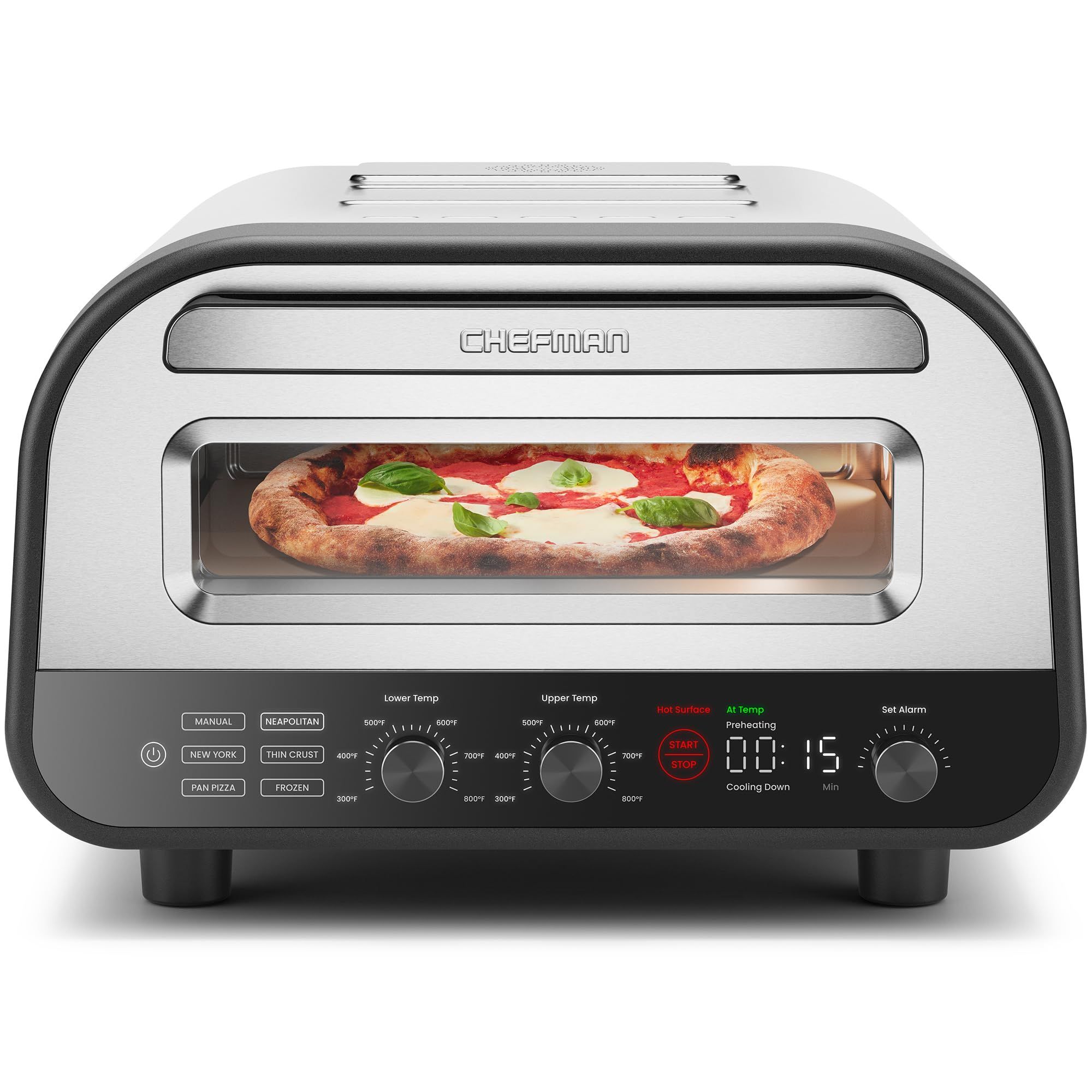
If you’re new to home pizza making, the Chefman model is an excellent place to start.
It has a sleek illuminated control panel with three knobs for the upper and lower heating elements, plus a timer. The clearly visible timer counts down and alerts you audibly when your pizza is done.
We love that you don't have to rely on the user manual to learn your machine, thanks to simple presets for Neapolitan, New York, thin-crust, pan, and frozen pizza. There's also a manual mode to make adjustments for a crisper or softer pie.
The oven has a deep interior and includes a square stone. It sits on legs that help protect your countertop and position the oven door closer to chest level, which is helpful when maneuvering pies.
During lab testing, we had to add two minutes to the recommended 2.5-minute cook time for a Neapolitan pizza, but it came out golden brown with a puffy crust and a lightly smoky taste. Frozen pizza came out a little unevenly colored, but the cheese melted nicely.
This pizza oven took 22 minutes to preheat to its highest temp, which is faster than many others, but the stone didn’t show totally even heat distribution: the front was 225°F cooler than the center of the stone. Because of this, we recommend preheating the oven longer than the recommended time and using an infrared thermometer to ensure your stone is hot enough before launching pizzas (ideally 750°F to 800°F for Neapolitan-style).
This oven comes with a perforated peel, which actually made it harder to launch pizzas because the semolina flour we use to keep the dough from sticking to the peel slipped through the holes. This left a mess on the floor and caused the dough to stick.
| Dimensions | 18.7" x 17" x 10.94" |
| Capacity | 12-inch pizza |
| Temperature range | 300˚F–800°F |
| Weight | 23.3 lbs |
Other indoor pizza ovens we tested

- Ooni Volt 2: We’re big fans of Ooni’s outdoor ovens, and we like that this electric model is easy to use and powerful. However, it’s pretty bulky and can be noisy when cooking.
- Panasonic Flash Express 6-in-1 Indoor Pizza Oven Air Fryer: This new model from Panasonic also functions as an air fryer, which is handy if you’re choosing between the two appliances. While it preheated evenly and our Neapolitan pizza came out beautifully, it didn’t perform as well with frozen or thin-crust pizza as our top picks.
- Pizza Girl Pizza Oven: This is a cute, compact model that saves you storage space, but it isn’t as durable as our picks above.
How we test indoor pizza ovens

In the Kitchen Lab, we’ve tested over 30 indoor and outdoor home pizza ovens—that’s over 90 pies, not including the many pizzas we make at home for long-term testing and pizza nights. We evaluate each model for ease of use and performance.


✔️ Neapolitan pizza test: To assess the oven’s ability to reach high temperatures, we make a homemade pie on the Neapolitan setting and track the time to preheat, the actual temperature of the pizza stone, and how long the pie takes to cook.
Whenever possible, we use the oven’s included accessories, such as peels, to launch and remove pies from the oven. We evaluate the crispness of the crust, whether it has puffy bubbles, and the evenness of the cheese melting and color.

✔️ Thin and crispy test: After letting the oven cool down, we test the “thin” setting, which usually cooks at a lower temperature for up to seven minutes. This shows us how well the oven can produce a longer-cooked pie. We compare the pizzas cooked on both settings, looking for differences in crust quality, color, and evenness.
✔️ Frozen pizza test: We make a DiGiorno frozen cheese pizza in each oven according to the oven recommendations for frozen pizza. We assess how evenly the cheese melts and whether the crust has any noticeable dark or under-baked spots.
✔️ Ease-of-use tests: We evaluate the helpfulness of the owner’s manual, usability of the control panel, features like alerts, oven lights, and accessories, as well as how easy the oven and accessories are to clean.
What to look for when buying the best indoor pizza oven

✔️ Desired pizza style: Most importantly, consider the type of pizza you want to make. It's hard to achieve "wood-fired" results indoors, but to get close, choose an oven that can reach 750°F or higher for potential charring.
If you mostly cook frozen pizzas, there's no need to spend big bucks. Your full-size oven, toaster oven, or our best value pick, Presto Pizzazz Plus Rotating Oven, will work great.
✔️ Customizability: Several of our favorite ovens allow you to control the temperature of the top and bottom elements individually. We love this level of customization because it offers more precision over your cook, but it might not be necessary for everyone.
✔️ Size: Most indoor pizza ovens are roughly the size of a toaster oven, but some are quite deep, which requires more space on your counter and for storage. Our favorite models can accommodate a 12-inch pizza. Also consider the oven’s weight if you plan on moving it; they can be quite heavy, especially with the stone inside.
✔️ Extra accessories and features: Most of the pizza ovens we tested came with pizza peels; some came with additional pans for deep-dish pizza. We find timers, audible alerts, and interior lights helpful when making pizzas.
Why trust Good Housekeeping?

Lizzy Briskin is a contributing analyst in the Kitchen Lab. She tested the most recent round of indoor pizza ovens for this guide and uses her home oven nearly every week for family pizza nights. She prefers Neapolitan-style with prosciutto.
Eva Bleyer is the analyst in the Kitchen & Cooking Lab. She led the Lab's pizza stone testing and has tested indoor and outdoor pizza ovens. She's the team's resident pizza maker and often makes them for photo shoots.
Nicole Papantoniou is the senior director of Kitchen & Cooking at GH. She has been testing kitchen products since 2019, including at least 10 outdoor pizza ovens. She's a trained cook and recipe developer, and she has made too many pizzas to count.
For this guide, the team worked with Anthony Mangieri, the chef and owner of Una Pizza Napoletana in New York City, who helped us test indoor pizza ovens.
Eva (she/her) is the Reviews Analyst in the Kitchen & Cooking Lab. She tests kitchen appliances, cooking tools, and cookware using standardized lab protocols in order to help consumers make informed purchasing decisions. With more than 15 years of experience in the food industry—including work as a food stylist, personal chef, and food brand marketing manager—she brings both culinary expertise and practical insight to every review. Eva earned a Bachelor of Science in Food Studies, Nutrition and Public Health from New York University. She completed her culinary training at the Natural Gourmet Institute (now the Institute of Culinary Education) and holds foundational and intermediate barista certifications from the Specialty Coffee Association.
Nicole (she/her) is the senior director of the Good Housekeeping Institute Kitchen & Cooking Lab. She oversees all content and testing related to kitchen products, food, and recipes. She has worked at GH since 2019, and is a trained cook, published recipe developer, and seasoned product tester with nearly 15 years of experience. She has worked in test kitchens for national magazines and kitchen appliances brands, where she also helped develop products for the home cook. She earned a degree in journalism from SUNY New Paltz, graduated with a Grand Diplome in Classic Culinary Arts from the French Culinary Institute, and studied culinary nutrition at the Natural Gourmet Institute (both now part of the Institute of Culinary Education in New York City.)
Readers Also Read

50 Best Gifts for Men

The Best Outdoor Pizza Ovens

2027 Good Housekeeping Kitchen Award Winners

30 Unique Gifts for the Whole Family


