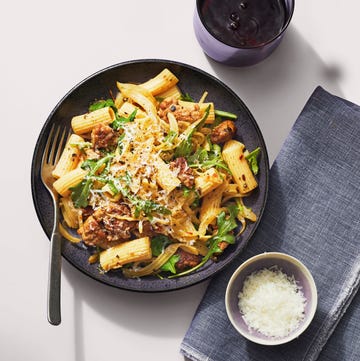
If you're looking for creative ways to increase your protein intake, you're in the right place. Most people think of carbs, not protein, when they're thinking about pasta. But there's one pasta trick that gives dinner a serious protein boost: Adding ricotta.
This creamy, savory cheese packs a surprising amount of protein into a half-cup serving. Stirring it into your sauce or adding a dollop on top can significantly increase the amount of protein in your dinner. And as sports dietitian Roxana Ehsani, MS, RD, CSSD, points out, adding ricotta to pasta has plenty of other upsides. It can help regulate blood sugar and ensure you're getting bone-supporting nutrients, among other benefits.
If you're looking for other ways to make pasta night more of a protein party, consider adding shrimp, chicken, anchovies, or salmon to your pasta. If you're looking for plant-based proteins other than ricotta, you can also try stirring Greek yogurt or cottage cheese into your pasta sauce. The beauty of pasta, after all, is that it's incredibly versatile. You can't go wrong (unless you're under-salting your pasta water, of course).
Keep reading for more expert input on why ricotta is the perfect protein boost for a pasta dinner.

Why ricotta works so well as a pasta add-in
While ricotta is often associated with lasagna, ravioli, or stuffed shells, a scoop can be dolloped on top of the finished dish or stirred into the sauce, instantly adding creaminess along with a meaningful nutritional boost. A 1/2 cup of part-skim ricotta cheese contains 171 calories, 9.8 g fat, 6 g carbs, 0 g fiber, and 14 grams of protein, according to Ehsani. That protein content, in particular, can make a noticeable difference in how satisfying a bowl of pasta feels.
Protein makes pasta more satisfying
“Adding a serving of ricotta into pasta will bump up its protein content, making it more filling and satisfying,” says Ehsani. She also notes that adding the ricotta (or any other protein source for that matter) “may lead a person to eat less overall pasta when a protein source is included.” Protein plays an important role in satiety, and including it in a meal that’s otherwise heavy on carbohydrates can help you feel fuller for longer.
Ricotta can help support steadier blood sugar
That balance matters for blood sugar, too. “Adding a source of protein like ricotta also supports better blood sugar levels helping support balanced blood sugars as protein slows down digestion and absorption of carbs,” says Ehsani. For people who notice energy crashes after carb-heavy meals, this kind of pairing can help smooth things out.
It adds bone-supporting nutrients to pasta night

Ricotta also contributes nutrients that aren’t always top of mind when thinking about pasta night. “Looking to support your bones? Adding ricotta into pasta will boost up your bone-building calcium, as one 1/2 cup serving will provide 337 mg of sodium, an excellent source of calcium, 26% of your daily value,” says Ehsani. Calcium plays a key role in bone health, particularly as we age, and ricotta offers a way to include it in a savory, familiar dish.
Ricotta is lower in sodium than many other cheeses
Compared with many other cheeses, ricotta can also be a gentler choice from a sodium standpoint. “Ricotta cheese is lower in sodium compared to other cheeses,” says Ehsani. “For someone with high blood pressure or diabetes for example, using ricotta cheese over cottage cheese or other shredded cheeses like parmesan is a better option. A 1/2 cup serving of ricotta cheese contains only 123 mg of sodium.” That can be helpful for people trying to keep sodium intake in check without giving up cheese entirely.
It delivers vitamins beyond protein and calcium
Beyond protein and calcium, ricotta provides other nutrients that quietly support overall health. A 1/2 cup serving of ricotta also supplies a good source of vitamin B12, about 15% of your daily value, according to Ehsani. “B12 is important for creating red blood cells and supporting a healthy nervous system.” It also delivers vitamin A — about 15% of your daily value — which supports eye health and immune health, confirms Ehsani.
When ricotta may not be the best choice
That said, ricotta isn’t a perfect food, and it may not be the best fit for everyone. “Ricotta does contain 6 grams of carbs per 1/2 cup serving,” says Ehsani. “Other cheeses like mozzarella for example, have much lower amounts of carbs per serving. A 1/2 cup serving of shredded mozzarella contains just 1.75 g of carbs.” For people closely monitoring carbohydrate intake, that difference may be worth considering.
Other creamy options to try instead

If ricotta isn’t your preference, there are alternatives that can play a similar role. “Cottage cheese or even plain Greek yogurt [can also be used],” says Ehsani, though the protein content varies and is usually lower, and obviously Greek yogurt won’t provide the same cheesy flavor.
Ultimately, adding ricotta to pasta will make a familiar meal a little more nourishing in the protein department, as well as some added vitamin benefits, but if you’re watching carbs you may want to check out other options.