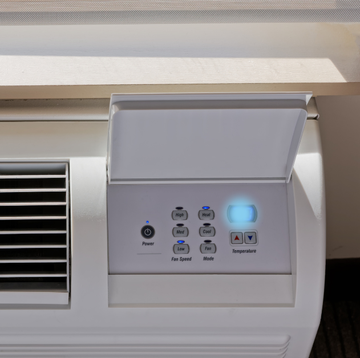
Most of the window air conditioners I’ve tested over the last 25 years have the same basic, industrial-looking design. Windmill, a newer brand that’s been gaining traction across Instagram and TikTok, is aiming to change that with a sleek, minimalist look that feels more like modern home decor than a clunky appliance—an important distinction for something that often sits prominently in the middle of a room. The company’s signature unit has even earned the nickname “the iPhone of air conditioners,” thanks to its Apple-inspired styling, including rounded edges and metal-mesh detailing.
Our team in the Good Housekeeping Institute Home Improvement & Outdoor Lab tested the Windmill AC (along with dozens of other units) for more than 18 months, evaluating how quickly, quietly, and efficiently each model cooled a space. Based on our extensive testing, I can confirm that the Windmill is not only one of the most stylish window air conditioners on the market, but also one of the best performers.

What's special about the Windmill AC?
Since we’re talking looks, let’s start there. Most window ACs made in the last 50 years have two distinct features—a horizontal grate that blows cool air into the room and a front-facing control panel, either with manual knobs or a digital display. By moving both the grate and control panel to the top of the unit, the Windmill has a far less cluttered design.

Meanwhile, its magnetic, mesh-front panel is a chic alternative to the usual plastic grille. For even more style points, the panel comes in standard white or a range of pastel hues. The Windmill also features cosmetic panels with integrated end caps that conceal its accordion-style side panels for a cleaner, sleeker look. Finally, the LED display dims automatically after a few seconds.
The design of the Windmill AC isn’t the only thing that’s less noisy: It’s also one of the quietest ACs we tested, making it an ideal choice for bedrooms or TV rooms. The quiet operation is a factor of the Windmill’s inverter technology, which replaces the compressor used on standard ACs. Whereas compressors basically run all the time, the Windmill’s inverter sends power to the AC in controlled increments. Besides reducing noise, this engineering improves temperature control and energy efficiency.
All that design and innovation comes at a cost, with the Windmill priced higher than many comparable units. For example, the best-value pick in our roundup of top window ACs, an 8,000-BTU Frigidaire, sells for about half as much as the Windmill.
How does the Windmill AC perform?
The Windmill cooled quickly and accurately during our tests in the Lab and in the homes of our three consumer testers. “My old AC wouldn’t circulate the air well, so in some parts of my room, it would be freezing, and in others it would still be hot,” one tester explained. Our experts credit the Windmill’s airflow design, with air blowing from the top of the unit at a 45-degree angle, with this superb cooling power. “This AC circulates the air perfectly, so it’s the same temperature in every corner,” added the tester.
The Windmill was also very easy to install, thanks to the built-in frame that makes it a cinch to attach the unit securely to your window. “So simple!” said one tester. “It took about 15 minutes to get everything situated securely in the window.”
Another praiseworthy feature of this window AC is its Wi-Fi connectivity, which lets you control it via the smartphone app or by voice commands with your Alexa or Google Assistant smart speaker.
How much cooling power does the Windmill AC deliver?
The Windmill AC comes in four sizes measured in BTUs (British Thermal Units), which correspond to the square footage of a room. Even larger Windmill ACs have a smaller housing than most comparable ACs, so they’re more likely to fit in your window opening.
- 6,000-BTU model is suited to rooms 100 to 200 square feet.
- 8,000-BTU model can cool rooms 200 to 400 square feet.
- 10,000-BTU model is best for areas between 400 and 600 square feet.
- 12,000-BTU unit is best for areas greater than 600 square feet.
If the area you need to cool is larger than that, you're better off with a more powerful window AC from another brand. (Our experts tend to like Friedrich for extra-large cooling needs.)
How we tested the Windmill AC
As with all home comfort equipment, from air purifiers to dehumidifiers, testing of the Windmill AC took place in the Home Improvement & Outdoor Lab, as well as in the homes of consumer testers, enabling us to evaluate the machine in real-world conditions.

Testing focused on the following factors:
✔️ Cooling power: Our experts measured how quickly the Windmill cooled a room and how consistently it maintained target temperatures using built-in sensors.
✔️ Ease of use: We evaluated how easy the Windmill was to install and set up, how well it fit different window types, and how simple it was to remove, clean, and reinstall the filter. We also assessed convenience features, including Wi-Fi connectivity and app controls.
✔️ Noise: Engineers in the Lab used a sound meter to measure loudness at different fan speeds and an anemometer to measure airflow. Home testers also evaluated noise during everyday activities like watching TV and sleeping.
Bottom line: Is the Windmill AC worth it?
You can’t believe everything you see on your social media feeds. But in the case of the Windmill AC, the hype is real. As one tester told us, “I am seriously obsessed with this AC! It has made such a difference this summer as my room is truly a cool oasis.” Another called the Windmill “the perfect AC for our small living room. It’s so much quieter than our old model, which means we don’t have to blare the volume to watch TV or yell at each other when we have something to say.”
Why trust Good Housekeeping?
Dan DiClerico has been testing and writing about air conditioners for more than 25 years. As director of Home Improvement & Outdoor at the Good Housekeeping Institute, he oversees all window AC testing in our Labs, as well as the continuous in-home, survey-based consumer testing that allows us to evaluate the equipment in real-world conditions. He is also a regular at trade shows and other industry events, where he keeps up with the latest in home cooling.