
I interviewed my colleagues—the professional cooks in the Good Housekeeping Institute Kitchen & Cooking Lab and Test Kitchen—and each and every one loves an enameled cast-iron Dutch oven. The durable, versatile pot can be used to simmer, boil, fry, braise, and bake. And the brand that's mentioned again and again is Le Creuset. Better yet, if you've been considering investing in one, the iconic Le Creuset Dutch oven is currently 32% off for Prime Day.
I've personally been using the same Le Creuset Dutch oven for more than 20 years. (She's a stately gray the brand doesn't even offer anymore.) I'm also the deputy editor for the GH Institute, where I test kitchen appliances and cookware, including Dutch ovens. Here's why the brand, which has been making cookware since 1925, is worth it.

Pros
- Heats evenly for great results whether browning, simmering, braising, or baking
- Easy to clean
- Extremely durable, lasting for decades
- Wide array of gorgeous colors

Cons
- While true of nearly all cast iron dutch ovens, these pots are heavy
- It generally costs more than its competitors

What to love about Le Creuset Dutch ovens

✔️ Even heat distribution
Le Creuset earned a high score in our Lab’s heat distribution tests. That means the cookware absorbs and distributes heat well, resulting in even cooking throughout the pot with minimal hot spots. This top level of performance is one of the reasons this pot earned a GH Kitchen Award.
✔️ Great heat retention
In addition to distributing heat well, cast iron retains heat efficiently, so you get consistent heat throughout your cook. Plus, foods will cool slowly and gently when you remove the pot from the heat. Senior Food Editor Susan Choung, who has been using her Le Creuset Dutch oven since 2013, appreciates this ability, saying, “It’s especially great for cooking Korean stews, which tradition dictates must be served scalding hot at the table.”
✔️ Smart design and tight-fitting lid
Kitchen & Cooking Lab Director Nicole Papantoniou notes that the cookware's shape plays a role in its ability to deliver consistent results. “The Le Creuset Dutch oven has a rounded bottom at the edges, which makes it easy to scrape down the interior of the pot,” she says. “And the straight sides, coupled with the tight-fitting lid, help the pot retain heat and moisture, which is perfect for braising. The meat in the stew we made in our Lab test was so moist and tender.”

✔️ Easy to clean
The enamel coating provides a slick surface that cleans up well while resisting staining. Food Producer Tina Martinez, who's been using her Le Creuset Dutch oven for nearly 25 years, says, "Even if I scorch the bottom, by some miracle it's so easy to clean and never is ruined. It's magic!" The company says the Dutch oven can be cleaned in the dishwasher, but we don’t recommend it: It's easy to wash by hand and can extend the life of your coating.
Looking for a step-by-step on cleaning? Check out our Cleaning Lab's tips on how to clean an enamel cast-iron Dutch oven. One piece of advice: It's best to clean any splatters on the outside of the pot quickly, because they can lead to staining or discoloration over time.
✔️ Suitable for any range
Enameled cast iron is compatible with any cooktop, including induction, and Le Creuset's Dutch ovens are oven-safe to at least 390°F/190°C (some pots have lid knobs that are safe to or beyond 500°F/250°C).
✔️ Light-colored interior
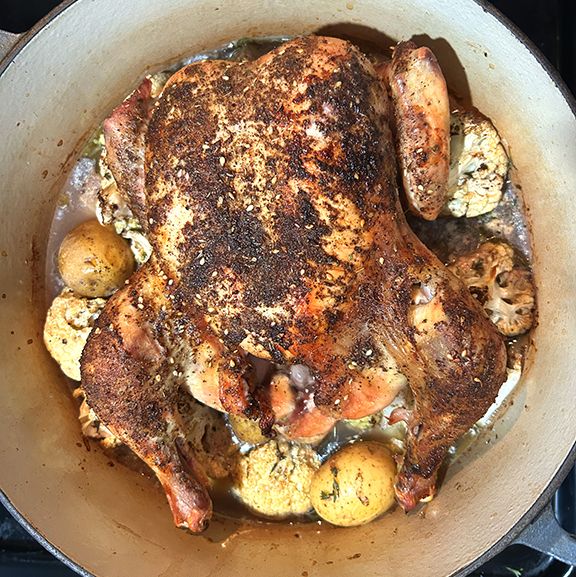
Traditional cast iron is black, inside and out. But Le Creuset’s enamel coating gives the pot’s interior a light ivory color. This is a great feature because it allows you to see how foods are browning. You can also make sure you scrape up all the flavorful browned bits when deglazing your pot after searing.
✔️ Extremely durable
Cast iron is known for taking a beating while lasting for generations. Several staffers have had their pots for 20 years or more and still use them with out-of-the-box success. Our in-house nutritionist, Stefani Sassos, R.D.N., says: "I’ve had mine for over seven years, and it still looks and performs as good as new. No scratching, chipping, or damage—despite heavy repeated use."
✔️ Big handles
The handles are sized for comfort and help keep the pot balanced. Says Kitchen Lab Reviews Analyst Eva Bleyer: “They’re easy to grasp, which is so important for such a heavy piece of cookware.” Papantoniou adds: “The lid knob is also wide and comfy to hold.”
✔️ Gorgeous colors
Le Creuset’s cookware comes in 24 colors; most have a shiny finish, but the brand now offers a matte finish as well. Bleyer likes that the saturated colors mean the Dutch oven can double as decor: “When I’m not using it, it’s a beautiful pop of color on my stovetop. I’m building a collection of different colors.” Sassos agrees: “I always keep this pot out, and there is no other pot or pan that I do that with.”
Some things to note
✔️ Heavy
The high durability of cast iron comes with some serious heft. This is true of most Dutch ovens, but it's worth noting nonetheless. Le Creuset's 5.5-quart model is listed at 11.31 pounds. One consumer tester reported, "You need to use two hands to lift it. I would not want to be cooking with this every day because of its weight." That said, while Le Creuset tends to be heavier than Lodge (which offers a 6-quart version at the same 11.31 pounds), it is often lighter than Staub (where the 5.5-quart pot clocks in at 14.52 pounds).
✔️ Costs more than some other brands
Le Creuset tends to be pricier than its competitors. There are Amazon Prime Day sales and Black Friday/Cyber Monday deals for those looking to score a discount. And the brand hosts Factory to Table sales that you can find on the Le Creuset site; they require a ticket but offer savings and sometimes access to exclusive colors or products. But even if you pay full price, you get a pot that performs well and won't need to be replaced, so the purchase is a sound long-term investment.
How we test Dutch ovens
In the Good Housekeeping Institute Kitchen & Cooking Lab, we have tested more than 25 Dutch ovens over the years, and I've tested many of the latest models. I rate each pot on how it heats, cooks, and cleans.
- I prepare a beef stew to evaluate the Dutch oven's ability to brown meat and simmer steadily and evenly.
- During cooking, I note whether the handles are comfortable and whether they stay cool.
- After cooking, I wash the pot to see whether it cleans easily without staining or chipping.
- I weigh each Dutch oven and check whether the lid fits tightly to trap heat and steam for even cooking.
- I also perform a test to show the pot's heat distribution and responsiveness: I coat the bottom with shortening and a thin layer of flour, then heat the pot until the flour browns. The level of browning is then evaluated against a standardized chart. I check the browning pattern to note hot spots in the pan; a uniform pattern indicates that the pot evenly distributes heat.
- In addition, the Kitchen Lab team has sent some Dutch ovens to consumer testers for feedback, and we factor their experience into our recommendations.
How does Le Creuset compare to other brands?
There’s no getting around the price: Le Creuset Dutch ovens tend to be more expensive than other brands. Its 5.5-quart pot is around $435. By comparison, two of the top competitors—French company Staub and American maker Lodge—are $300 for a larger 7-quart version and $50 for a 6-quart model, respectively. Both brands are recommended among our top Dutch ovens.
Staub is known for its lid with bumps (“picots") that collect steam and redirect the moisture back onto the food—sometimes called a "self-basting lid." It can be helpful for long braises. That said, Staub did not do as well in our heat distribution test as Le Creuset did.
Lodge’s enamel cast-iron Dutch oven is wider and has flared sides. (We tested the 6-quart model, as the company does not make a 5.5-quart.) Its lid is more domed than Le Creuset’s, and Papantoniou noted that condensation spilled onto the stovetop, meaning that the lid did not fit as tightly or redirect steam as efficiently. The meat was tender but less moist than Le Creuset’s. But it’s a gorgeous piece for the price: It offers a similar light-colored interior for monitoring browning, and it does retain heat well.
The bottom line: Is the Le Creuset Dutch oven worth it?
Yes. It's worth the high price tag because it delivers consistently great results and will last for decades. It excels at both browning and deglazing (read: It creates tons of flavor for your dishes). It will resist staining and chipping while being easy to clean. It's also available in a ton of colors, which makes the cookware feel more personal and can match your kitchen's aesthetic.
Why trust Good Housekeeping?
Sarah Gregory leads the testing of Dutch ovens for the Good Housekeeping Institute, and she has been using Le Creuset Dutch ovens for more than 20 years, including as a recipe developer. She also tests slow cookers and carbon steel pans for Good Housekeeping. She is a graduate of The International Culinary Center (now the Institute of Culinary Education).


